
Linear vs Switching Power Supply for LED Strips
Linear vs switching power supply for LED strips: compare efficiency, heat, size, ripple and cost, then pick by power and ripple needs.
On This Page
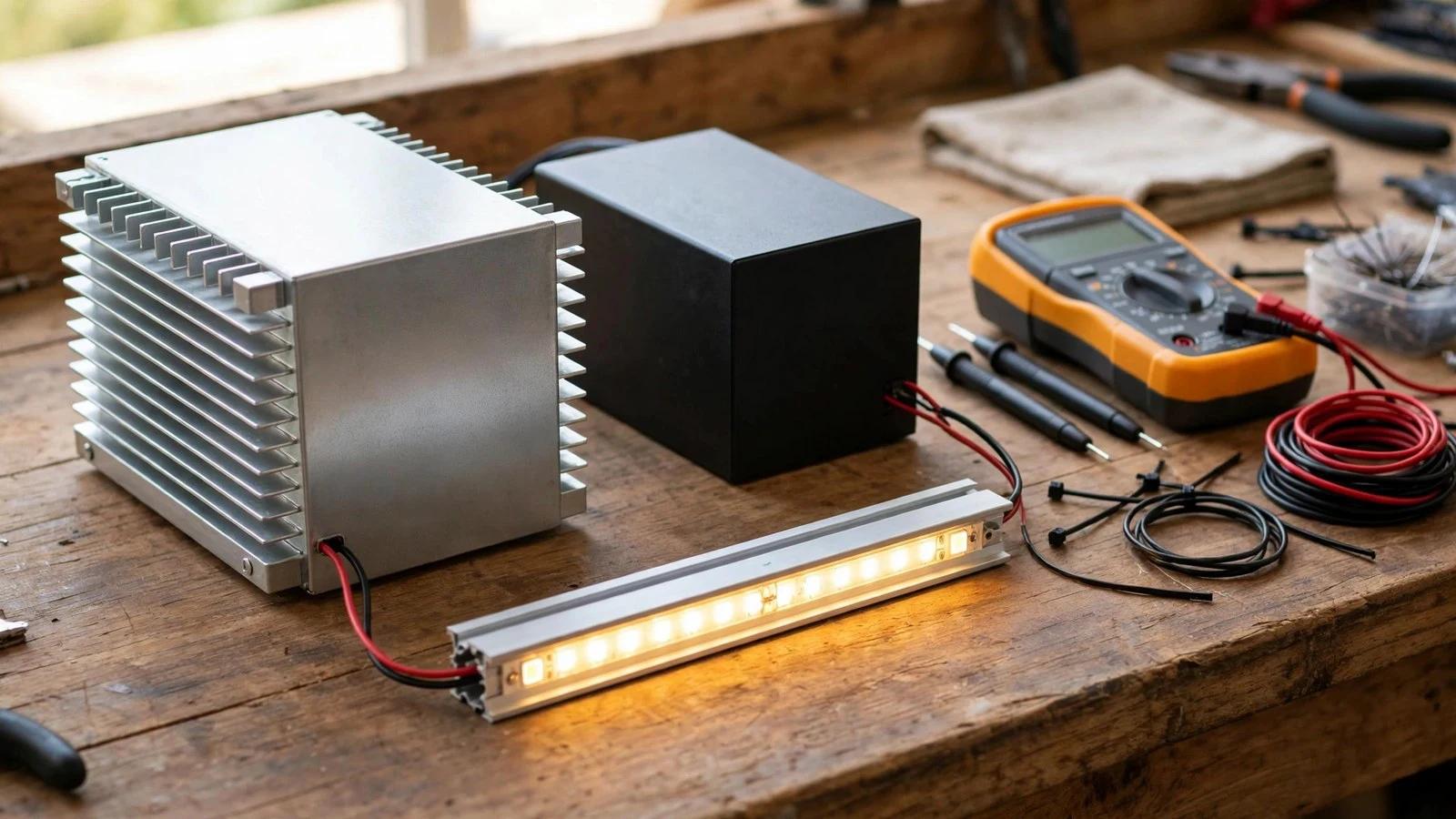
A linear power supply steadies voltage by burning excess energy as heat, while a switching power supply converts energy through rapid on-off switching. The first gives very clean output but wastes power, and the second runs cooler and smaller but adds ripple and electrical noise. For LED strips, the right choice depends first on power level, space, and how sensitive the scene is to ripple.
Most LED strip projects use a switching supply as the default, because strips often run long and draw real power. A linear supply still has a place, but only where clean output matters more than efficiency or size. This guide compares the two topologies side by side, so you can match the supply to the job. It covers efficiency, heat, size, ripple, cost, and the questions to ask before you buy.
How Each Supply Works
A linear supply takes the input voltage and drops the extra volts across a series element, which turns the surplus into heat. The design is simple, with few parts and no high frequency switching, so the output stays smooth and quiet. The trade-off is direct, because every volt dropped at full current becomes heat that must go somewhere. Large heat sinks add bulk, and the supply grows fast as power rises, which limits its use in big runs.
A switching supply chops the input at high frequency, stores energy in small magnetic parts, and rebuilds a steady output. High frequency switching shrinks the transformer and the filter parts, so the unit stays small and light. The cost is ripple and electrical noise, which need filters, shielding, and good layout to keep under control. Modern designs handle this well, but the noise never falls to the near zero level of a linear supply.
Linear vs Switching Power Supply: Comparison Table
The table below puts the two topologies side by side on the points that matter most for LED strip projects. Read it as a guide to trade-offs, not as a scorecard, because no topology wins on every point. Efficiency ranges come from published comparisons, and sources disagree, so always check the power supply datasheet.
| Point | Linear supply | Switching supply |
|---|---|---|
| Principle | Series element drops extra voltage as heat | High frequency on-off switching with small magnetics |
| Efficiency range | 30–60% in most comparisons, some sources say 40–60% | 70–95% in most comparisons, some sources say 70–90% |
| Size and weight | Large and heavy, grows fast with power | Small and light, scales well with power |
| Heat | High, needs heat sinks and free air | Low, needs less cooling hardware |
| Ripple and EMI | Very low ripple and EMI | Higher ripple and EMI, needs filtering |
| Transient response | Fast, no switching loop to catch up | Slower than linear, control loop must adjust |
| Cost | Low at low power, high at high power | Higher design cost, scales better at high power |
| Best use | Audio, lab, and ripple sensitive scenes | LED strips and most mains powered lighting |
Two rows deserve a second look before you move on, because they drive most real decisions. Efficiency sets the heat load, and ripple sets the visual quality, so these two points frame the rest. A supply that looks cheap on price can cost more in cooling, space, and rework once it runs hot. Keep those two rows in mind as you read the detail sections, and the choice will stay simple.
Efficiency, Heat, and Size in Real LED Runs
Published comparisons put linear efficiency near 30–60 percent, while switching supplies reach near 70–95 percent in many designs. Other sources give narrower bands, such as 40–60 percent for linear and 70–90 percent for switching designs. Treat every figure as a range, not a promise, and check the power supply datasheet for the exact model. The gap matters because lost power becomes heat, and heat is what limits a supply in a closed channel.
A linear supply wastes a large share of input power at high drop, so it needs room for air flow and a heat sink. Inside an aluminum channel, trapped heat shortens the life of the supply and can stress the strip itself. A switching supply wastes far less, so it stays cooler and fits in tighter spots with less cooling hardware. Size follows the same logic, since high frequency parts shrink the transformer and the whole unit.
The driver concept behind these numbers is worth a quick review, since a driver sets how power reaches the strip. Our guide to 24V LED strip drivers explains constant voltage and constant current in plain terms for buyers. Read it before you size a supply, because the driver type shapes the ripple and control choices that follow. A clear driver picture also stops the common error of judging a supply by watts alone, with no other checks.
Ripple, Flicker, and EMI: When Clean Output Matters
Ripple is the small leftover wobble on the output voltage, and it can show up as flicker or uneven light on a strip. Linear supplies keep ripple very low by nature, since they smooth the output without fast switching edges. Switching supplies add ripple at the switching frequency, plus harmonics that can reach nearby audio or control lines. Filters cut the ripple down, but they add cost and size, and cheap units may skip the filtering you need.
Flicker risk rises where the eye or a camera can catch it, such as video studios, retail displays, and slow motion filming. In those scenes, test the strip and supply together under the real load, and watch the light at full dimming range. For plain ambient light in a hallway or a shelf, small ripple rarely shows, and a switching supply works well. Electromagnetic interference follows the same split, since fast edges radiate more than a slow linear stage does.
A linear supply answers fast when the load changes, because it has no switching loop to catch up with the demand. A switching supply reacts a little slower, since its control loop must sense the change and adjust the switching pattern. For LED strips, this gap rarely decides the job, since strip loads change slowly and dimming moves in small steps. Treat fast response as a bonus for sensitive loads, not as the main reason to pick a linear supply.
Decide by Power and Ripple Needs First
Start the choice with two questions, and let the answers pick the topology before you compare brands or prices. First, how much power will the run draw at full brightness, including every strip on the same supply? Second, how clean must the output be for this scene, and will anyone film it or stare at it closely? Power sets the heat and size budget, while ripple sets the visual bar, and both beat price as a guide.
| Scene | Typical power | Ripple need | Suggested topology | Watch out for |
|---|---|---|---|---|
| Small ambient run | Low | Low | Switching | Check the real load first |
| Large main lighting | High | Medium | Switching | Plan cooling and space early |
| Ripple sensitive scene | Low to medium | Very high | Linear, or filtered switching | Test the pair in the real scene |
Small ambient runs are the easy case, since low power keeps heat small and ripple rarely shows. Large main lighting pushes the other way, since high power makes linear heat hard to cool and hard to house. Ripple sensitive scenes are the only case where linear earns its place, and even there a filtered switching supply may pass. Test the real pair in the scene when the answer matters, because paper specs hide the flicker you will see.
Power without a plug is a separate question from topology, and it confuses many first time buyers of LED strips. Our guide to powering LED strips without a plug covers the safe supply routes and the plug free options buyers ask about. Read it alongside this page, since the supply route and the supply topology are two different choices to make. Keep the two choices apart, and each one stays simple to judge on its own merits.
Cost, Lifespan, and Practical Trade-Offs
Linear supplies look simple and cheap at low power, since they use few parts and need no complex control board. The cost flips as power rises, because big heat sinks, large transformers, and heavy cases add up fast. Switching supplies cost more in design and filtering, but they scale better, since small parts carry more power per gram. For most LED strips, the switching supply wins on total cost once you count cooling, space, and energy use.
Heat also shapes lifespan, since hot parts age faster and hot supplies fail sooner in closed or crowded installs. A cool switching supply often outlasts a hot linear unit in the same channel, even when both are built well. Check the cooling method on the datasheet, and ask whether the supply needs free air, a sink, or a fan. A fan adds noise and a moving part, so a passively cooled supply suits quiet rooms and sealed channels better.
Long runs add a second cost, since one supply must feed every strip, and voltage drop grows with length. Our guide to connecting multiple 12V LED strips to one supply shows the parallel wiring pattern that keeps brightness even. Use it when you plan a multi strip layout, since the wiring plan shapes the supply size you will need. A good wiring plan also spreads the load, so no single strip end goes dim while the start stays bright.
Buyer Questions Checklist
Ask these questions before you order, and judge the answers against the datasheet, not against sales claims alone. A supplier who answers in numbers is easier to trust than one who answers with broad promises and no figures. Keep the checklist with your quote request, so every supplier answers the same points and you can compare fairly.
- Ask the efficiency range at your real load, and check it on the datasheet
- Ask the ripple figure and the test load behind it
- Ask the cooling method, and whether free air is required
- Ask the headroom recommendation for your load, per the datasheet
- Ask for safety certifications and the test reports behind them
- Ask the input voltage range and the protection features built in
Wiring the supply to the strip is the next step, and it deserves the same care as the topology choice itself. Our guide to connecting LED strips to a power supply walks through the basic hookup steps for first time installers. Have a licensed electrician follow local regulations for any mains side work, and never improvise the mains connection. Low voltage strip wiring is simpler, but neat runs, firm joints, and correct polarity still matter for a stable result.
What This Means for Your LED Profile Project
NIUYUAN makes aluminum profiles for LED strips, and it does not supply drivers or power supplies of any kind. That split keeps the advice here generic, so you can take the topology logic to any brand you choose. The profile still matters, since a good channel spreads heat, shields the strip, and gives the install a clean finish. Pick the channel and the supply as a pair, and check that the supply fits the space the channel leaves free.
Profiles use 6063-T5 aluminum alloy, and the factory runs 6 in-house extrusion lines for custom and stock shapes. The factory covers 31,706 square meters, and it serves buyers in North America, Europe, the Middle East, and Oceania. More than 36,000 projects have used these profiles, and the team counts more than 250 people across the operation. Certifications include ISO 9001, RoHS, and CE, and buyers can ask for the documents that support each claim.
Minimum order is 1,000 pieces across the profile range, and tooling takes about 7 days for a new shape. Lead time runs 20–30 days from prepayment, while stock shapes ship in 3–7 days and custom shapes take 25–30 days. Samples are free with freight collect, and standard samples take about 7 days to reach the buyer. Use those facts to plan the profile order, and plan the power supply on its own datasheet and supplier advice.
Frequently asked questions
Which power supply is better for LED strips?
A switching supply suits most LED strips, since it runs cooler, stays small, and wastes less power at real loads. A linear supply fits only where very clean output matters more than efficiency or size.
Why does a linear power supply run hot?
It drops extra voltage across a series element, and the dropped energy becomes heat. The hotter it runs, the more cooling it needs, so it suits low power jobs best.
Does a switching power supply cause flicker on LED strips?
It can, since switching adds ripple to the output, and ripple can show as flicker in sensitive scenes. Good filtering cuts the ripple, so test the strip and supply together before a large order.
What size power supply do I need for my LED strips?
Add up the watts of every strip on the same supply, then leave headroom per the power supply datasheet. Ask the supplier for their headroom recommendation for your exact load.
Can I use a linear power supply for a long LED strip run?
It is rarely the right pick, since long runs draw real power and the linear supply turns the surplus into heat. A switching supply handles long runs better, with less heat and less space.

Share this guide
Tell us what you need
Send Your Project Requirements
Share your contact details and tell us which LED profiles you need.
Explore custom profile options