
How to Power LED Strips Without a Plug
No socket nearby? Learn 8 ways to power LED strips without a plug, from USB and battery packs to hardwiring, plus the safety rules to follow.
On This Page
The short answer
You can power an LED strip with no wall socket in sight, as long as the power source matches the strip voltage. The trick is to keep every connection on the low voltage side and pick a method that fits the spot. This guide covers eight methods, from a USB port to a hardwired driver, with the trade offs of each.
A short strip on a shelf needs little power, while a long run under a cabinet needs far more. The method that works for one can fail for the other, so start with the strip label. Note its voltage and its wattage per metre, then choose a power source that can feed that load with room to spare.
Three rules before you pick a method
Match the voltage. A 12V strip needs a 12V supply, and a 24V strip needs a 24V supply. Check both labels before you connect anything, since the wrong voltage can dim the strip or damage it.
Leave headroom. The power source should deliver more power than the strip draws. Follow the wattage limits printed on the strip and the driver instructions. A source that runs at its limit will run hot, and it may cut out when the strip needs a surge.
Mind the polarity. LED strips have a positive wire and a negative wire, and a swapped connection means the strip will not light. Some drivers are protected against a wrong connection, but many are not. Double check the plus and minus marks before you switch the power on.
Eight methods at a glance
The table below compares the eight methods. Pick the row that matches your spot, then read its section for the detail.
| Method | Best scenario | Typical strip voltage | Needs an electrician |
|---|---|---|---|
| USB port | Short strip on a desk or shelf | 5V | No |
| Power bank | Temporary light, display, or event | 5V | No |
| Battery pack | Cabinet, wardrobe, or drawer with no socket | 12V | No |
| Hidden power adapter | Fixed install near a socket in another room | 12V or 24V | No |
| Hardwired driver | Permanent kitchen or ceiling install | 12V or 24V | Yes |
| Car or boat battery | Vehicle, boat, or off grid cabin | 12V | No |
| Solar power | Garden, balcony, or outdoor path | 12V | No |
| Inverter | Long strip run from a vehicle battery | 12V or 24V | No |
01. Use a USB port
A USB port is the simplest way to power a short strip, since many 5V strips are made for this use. They plug straight into a laptop, a TV USB port, or a phone charger, and the setup takes about a minute.
USB power suits short runs only, because a standard USB port delivers limited power. Keep the strip short and check the wattage on the label first. If the strip is longer than the port can feed, the far end will look dim.
02. Use a power bank
A power bank works like a portable socket, so a 5V strip connected to it can light up anywhere the bank goes. This suits trade show displays, photo shoots, and temporary setups, and the display stays clean with no cable to a wall.
The catch is run time, since a power bank holds a limited charge and suits hours of use rather than permanent lighting. Check the bank output and the strip draw before you start. Keep a spare bank charged if the light must stay on through a long event.
03. Use a battery pack
A battery pack is a neat fix for cabinets, wardrobes, and drawers, since a small 12V pack sits inside. No socket is needed, no cable crosses the room, and many packs use common cells that are easy to replace.
This method suits short strips with modest power draw, so measure the strip length first. A long strip will drain the pack fast, so put the pack where you can reach it for a swap. If the light runs every day, a rechargeable pack will save you repeated battery costs.
04. Hide a power adapter nearby
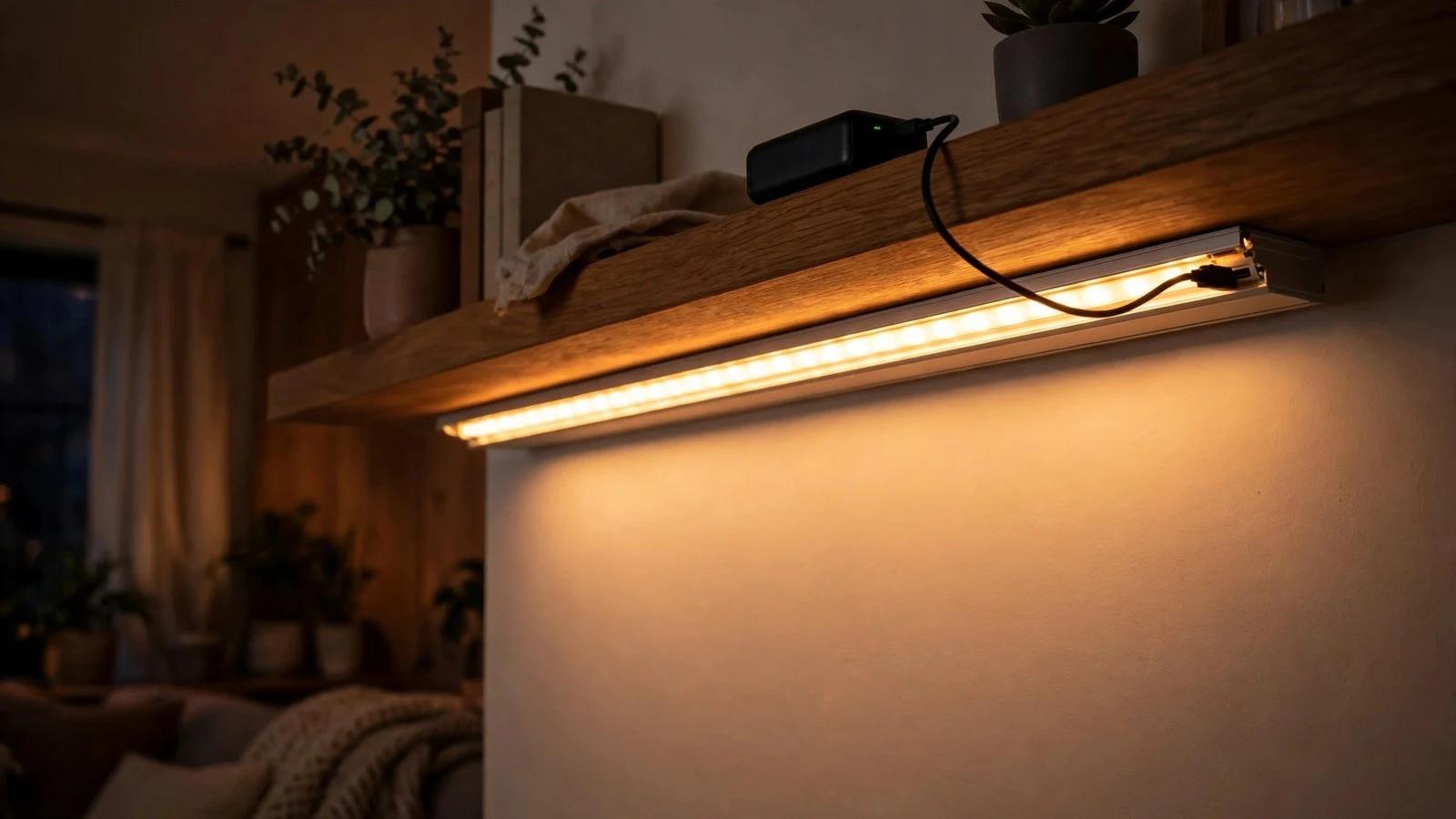
Sometimes the socket exists, just not in the right place. A low voltage adapter can sit in a nearby cupboard, behind a pelmet, or above a cabinet. A thin low voltage cable then runs to the strip, while the mains cable stays short and the visible run stays tidy.
This method suits fixed installs such as under cabinet lighting. The adapter must match the strip voltage and wattage, so check both labels before you buy. Keep the adapter where air can move around it, and never bury it inside insulation or seal it in a closed box.
05. Hardwire a driver into the household circuit
Hardwiring gives a clean permanent result, since the driver connects to the household circuit and the strip connects to the driver output. No socket and no visible adapter remain. This is the usual choice for kitchens, ceilings, and long fixed runs. Plan the driver location early in the job, since it needs ventilation and easy access for later checks.
Safety note: the strip itself only ever connects to the driver low voltage output. Never connect a strip directly to household mains, since the voltage will destroy the strip and can cause fire or serious injury. Hardwiring work should be done by a qualified electrician. Tell the electrician the strip voltage and total wattage before the work starts, and confirm that the driver matches both.
06. Use a car or boat battery
A 12V vehicle or boat battery can feed a 12V strip directly. This suits caravans, boats, food trucks, and cabins. The strip draws from the same battery that runs the vehicle lights, so the install is simple and no inverter is needed.
Check the battery voltage first, since a charging battery can read higher than 12V. Keep the strip fused. Keep the wiring away from moving parts and heat. Switch the strip off when it is not needed.
07. Use solar power
Solar power suits garden paths, balconies, and outdoor signs. A solar panel charges a battery during the day. The battery then feeds the strip at night. No mains cable runs outdoors.
Solar output depends on daylight, so this method suits decorative light rather than bright task light. Place the panel where it gets direct sun for most of the day. Keep the battery and the connections dry and out of standing water. Check the panel and battery ratings against the strip draw before you buy.
08. Use an inverter
An inverter turns battery power into mains power, which suits a long strip run from a vehicle battery. The inverter feeds the driver, and the driver feeds the strip, so you can reuse standard parts in a mobile setup.
Inverters add a step, so they suit larger setups rather than short strips. The battery must be able to feed the total load, so check its rating first. Check that the inverter output matches the driver input, keep the inverter ventilated, and fuse the battery side of the wiring.
How to choose the right method
Start with the strip, not the power source. Note its voltage, its wattage per metre, and its total length before you shop. Then ask three questions. Is the install permanent or temporary? Is there a socket in the next room? How long must the light run each day?
A short temporary strip suits USB or a power bank, while a cabinet strip with no socket suits a battery pack. A fixed kitchen run suits a hidden adapter or a hardwired driver, and an outdoor path suits solar power. A vehicle install suits a battery or an inverter. When two methods both fit, pick the one with the simpler wiring.
If your install uses an aluminum channel, plan the power route before you cut the profile. The driver or battery pack needs a home near the strip, and the cable needs a clean path into the channel end. Our guide to installing LED strip lights in aluminum channel walks through the fitting steps. See install LED strip lights with aluminum channel.
If you are still picking a profile, read our guide on how to choose the right LED aluminum channel. It covers the sizes and diffuser options for each install. For a run with unusual lengths or mounting needs, custom LED aluminum profiles can be made to order. They follow your drawings and your strip layout.
Finish and check checklist
Run through this list before you call the job done, and fix any item that fails first:
- Strip voltage matches the power source voltage.
- Power source wattage covers the strip load with room to spare.
- Positive and negative wires are the right way round.
- Every connection is firm, insulated, and out of reach of water.
- The driver or adapter has air around it and is not sealed in insulation.
- The strip lights evenly from end to end, with no dim tail.
- The strip sits flat in the channel, and the diffuser clips on cleanly.
- For hardwired work, a qualified electrician made the mains connection.
How this guide differs from our 24V COB guide
This guide answers one question. It covers how to power a strip where no socket exists. Our 24V COB guide answers a different one. It covers how long a single 24V COB run can be, and how to size the driver for it. Read this guide to pick a power method. Read the COB guide when you plan a long continuous run. See 24V COB LED max run length.
Frequently asked questions
Can I power an LED strip from a USB port?
Yes, if the strip is a 5V type and the run is short. Connect it to a laptop, TV USB port, or phone charger, and check the wattage on the strip label first. A long strip will dim at the far end if the port cannot feed it.
How long will a battery pack run an LED strip?
It depends on the strip wattage and the battery capacity, so there is no single answer. Check the wattage per metre on the strip label and the capacity printed on the pack. A short strip with modest draw will run far longer than a long bright strip on the same pack.
Can I connect an LED strip straight to household mains?
No, never. A strip must only connect to the low voltage output of a driver. Household mains voltage will destroy the strip and can cause fire or serious injury. Hardwiring the driver into the household circuit should be done by a qualified electrician.
Do I need an electrician to hardwire LED strips?
Yes, for the mains side of the work. The driver connects to the household circuit, and that connection should be made by a qualified electrician. The strip itself only connects to the driver low voltage output, which is the safe side of the install.
Can NIUYUAN supply the driver or power supply for my LED strips?
No. NIUYUAN makes aluminum profiles only, and drivers and power supplies are sourced separately by the customer. NIUYUAN can supply the channel, diffuser, end caps, and mounting parts for the install, and the driver choice follows the generic guidance in this article.

Share this guide
Tell us what you need
Send Your Project Requirements
Share your contact details and tell us which LED profiles you need.
Explore custom profile options