
What Is a 24V LED Strip Driver and Do I Need One?
A 24V LED strip needs a 24V driver to turn mains power into safe low-voltage DC. Learn what a driver does, when you need one, and how to size it.
On This Page
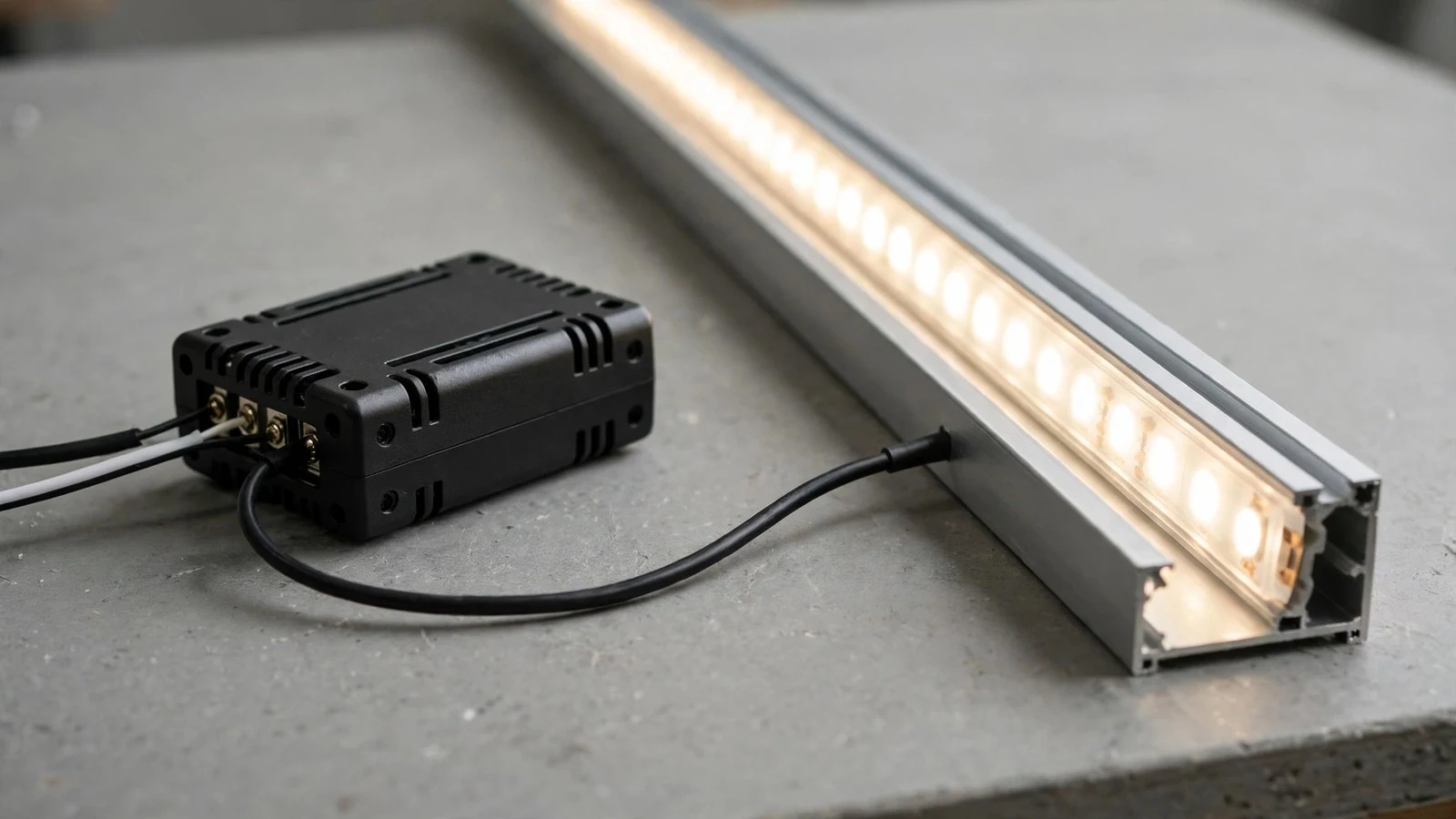
A 24V LED strip needs a 24V driver, and the answer to the second half of the question is yes. A driver, also called a power supply, turns mains power into the low-voltage DC power that the strip is built for. Without a driver, there is no safe way to run a 24V strip from a wall socket.
A driver is not an optional accessory. It is part of the circuit, just like the strip and the channel. The rest of this guide explains what a driver does, which type you need, and how to size one for your strip.
What a driver does
A driver takes mains power, which is high-voltage AC, and turns it into low-voltage DC. A 24V strip is built to run on 24 volts DC, so the driver must put out exactly 24 volts. The driver also steadies the output, so the strip gets a stable voltage even when the mains supply varies.
A strip must never be connected directly to mains power. Mains voltage is far higher than the strip is built for, and a direct connection will destroy the strip at once. It is also a safety risk. Every 24V strip installation needs a driver between the mains supply and the strip.
Most low-voltage strips, including 24V strips, use a constant-voltage driver. That means the driver holds its output at a fixed voltage, and the strip draws the current it needs. Constant-current drivers work the other way round: they hold the current steady and let the voltage vary. Constant-current drivers suit certain LED fittings, but a standard 24V strip needs a constant-voltage driver. Check the strip datasheet to confirm which type it needs.
Do you need one?
If your strip is a 24V strip, you need a 24V driver. There is no exception. The only question is which driver to buy, not whether to buy one. A strip that comes with a small plug-in driver still has a driver, so the driver is only hidden inside the plug.
The same rule applies at 12V. A 12V strip needs a 12V driver. The voltage of the driver must match the voltage of the strip exactly. A 12V driver will not drive a 24V strip correctly, and a 24V driver on a 12V strip can damage it. Check the voltage on the strip datasheet before you buy.
A single driver can feed more than one strip, as long as the total watts stay within the driver rating. Our guide to connecting multiple 12V LED strips to one power supply covers the same idea for 12V. The same parallel wiring rules apply at 24V. Our guide to powering LED strips without a plug covers the hardwired case. There, the driver is wired directly into the mains supply instead of using a plug.
How to size a driver
Sizing a driver is a simple method with three steps. First, read the power draw of the strip from its datasheet, in watts per metre. Multiply that value by the length of the strip in metres, and you have the watts for that strip. If one driver will feed several strips, add the watts of every strip together.
Second, add a margin on top of the total. A driver that runs at its full rated output all day runs hot, and heat shortens its life. A margin lets the driver run cooler and leaves room for small differences between strips. Pick a driver rated above the total watts of the strips it will feed, not one that only just matches it.
Third, check the voltage and the dimming type. The driver voltage must be 24V. The driver must also support the dimming method you plan to use, if you plan to dim the strip at all. A driver that cannot dim will not work with a dimmer, even if its voltage and power are right.
The sizing steps
| Step | What to do | Where the number comes from |
|---|---|---|
| 1 | Work out the total watts of the strips | The strip datasheet: watts per metre times length |
| 2 | Add a margin on top of the total | Your safety margin |
| 3 | Pick a driver rated above the final total | The driver datasheet |
| 4 | Check the voltage is 24V | The strip datasheet |
| 5 | Check the dimming type, if you plan to dim | The driver datasheet |
NIUYUAN makes aluminum profiles only, and it does not supply drivers or power supplies, so the customer sources the driver separately. That does not change the method above, and the same sizing steps apply whichever brand of driver you buy. Buy from a supplier that states its rated voltage, rated power, and dimming type clearly.
Plug-in driver or hardwired supply
There are two common ways to fit a driver. A plug-in driver plugs into a wall socket, and it suits a single strip or a small job where a socket is close by. A hardwired supply is wired directly into the mains circuit. It suits a larger job or a fitted installation where a plug would look untidy.
| Type | How it fits | Best for | What to watch |
|---|---|---|---|
| Plug-in driver | Plugs into a wall socket | One strip, or a small job near a socket | The plug and cable stay visible |
| Hardwired supply | Wired into the mains circuit | Fitted kitchens, coves, and shops | Needs a qualified electrician in most places |
A hardwired supply is often the better choice for a fitted job, because it hides away and can feed several strips from one place. Mains wiring must be done by a qualified person where the rules require it. Do not wire a driver into the mains supply yourself unless you are qualified to do so.
Indoor, outdoor, and dimming
A driver for indoor use does not need weather protection, but a driver for outdoor use does. Outdoor drivers are built to keep water out, and they carry an IP rating that states how well they are sealed. If the driver will sit outside, or in a damp place such as a bathroom, check the IP rating on the driver datasheet. Make sure it suits the location.
Dimming is a separate choice. The common dimming types are TRIAC, 0-10V, DALI, and DMX, and the driver must match the dimming system you plan to use. A TRIAC driver works with a mains dimmer, while 0-10V, DALI, and DMX drivers work with low-voltage control signals. Decide the dimming method before you buy the driver, because a driver bought for one method will not work with another.
Place the driver where air can reach it, and where you can reach it for service. A driver buried inside a sealed ceiling with no access panel is hard to replace when it fails. Keep the cable between the driver and the strip as short as the layout allows, because a long low-voltage cable loses voltage along its length.
Common mistakes
These mistakes cause most driver problems, and all of them are easy to avoid.
- Voltage mismatch: a 12V strip on a 24V driver, or a 24V strip on a 12V driver. Check both labels.
- Driver too small: the total watts of the strips exceed the driver rating. Add the watts up first.
- No margin: a driver rated exactly at the total watts runs hot. Pick a driver rated above the total.
- Strip wired straight to mains: a 24V strip must never connect directly to a wall socket. It needs a driver in between.
- Reversed polarity: the positive and negative wires are swapped at the strip. Mark the positive wire and test before mounting.
- Wrong dimming type: the driver does not match the dimmer. Decide the dimming method first.
- Driver hidden with no access: the driver fails one day and cannot be reached. Plan an access point.
Our guide to 24V COB max run length explains how the length of a run affects brightness. It also shows how to split a long run into sections fed in parallel. That guide also covers driver power for long runs in more detail.
Ordering profiles for a 24V strip job
A 24V strip job still needs the right profile, because the profile decides how the strip sits, how it cools, and how the light spreads. A channel that fits the strip width gives an even line of light with no dots. Our guide to installing LED strip lights in an aluminum channel walks through the mounting steps.
NIUYUAN is a LED aluminum profile manufacturer founded in 2012, with 6 in-house extrusion lines and OEM/ODM support. The minimum order quantity is 1000 pieces, and lead time is 20–30 days from prepayment. New tooling takes about 7 days, and standard samples take about 7 days. Samples are free with freight collect. For custom lengths or profiles, see our custom LED aluminum profiles page.
Frequently asked questions
What is a 24V LED strip driver?
A driver, also called a power supply, turns mains power into the low-voltage DC power that a 24V strip needs. A 24V strip is built to run on 24 volts DC, so the driver must put out exactly 24 volts. The driver also steadies the output, so the strip gets a stable voltage even when the mains supply varies.
Do I need a driver for a 24V LED strip?
Yes. Every 24V strip needs a 24V driver between the mains supply and the strip. A strip must never be connected directly to mains power, because mains voltage is far higher than the strip is built for. A strip that comes with a small plug-in driver still has a driver, hidden inside the plug.
How do I size a driver for a 24V LED strip?
Multiply the strip length in metres by its power draw in watts per metre, then add a margin on top. If one driver feeds several strips, add the watts of every strip together first. Pick a driver rated above the final total, with a voltage of 24V and a dimming type that matches your dimmer, if you plan to dim.
Can one driver power several 24V LED strips?
Yes, as long as the total watts of all the strips stay within the driver rating, with a margin to spare. Wire the strips in parallel, so each strip has its own direct path to the driver and gets the full 24 volts. Do not wire them in series, because the voltage would be shared and the last strip would look dim.
What is the difference between a constant-voltage and a constant-current driver?
A constant-voltage driver holds its output at a fixed voltage, and the strip draws the current it needs. A constant-current driver holds the current steady and lets the voltage vary. A standard 24V strip needs a constant-voltage driver. Check the strip datasheet to confirm which type it needs before you buy.

Share this guide
Tell us what you need
Send Your Project Requirements
Share your contact details and tell us which LED profiles you need.
Explore custom profile options