
What to Know Before Buying COB LED Strips
Buying a COB LED strip? Check density, CRI, voltage, IP rating and profile fit on the datasheet first. A five-item pre-order checklist.
On This Page
A COB LED strip purchase is a checklist decision, not a single-number choice, because five factors must match first. Chip density decides whether the light looks smooth. The color rendering index decides whether colors look true. Voltage decides how far one run can go. The IP rating decides where the strip can be installed. The inner width of the profile decides whether the strip fits at all.
Many buyers start with brightness and price, then learn too late that the strip does not fit the profile. A miss on any one item can force a full rework. The cheapest strip can turn into the most costly order. This guide gives a five-item check to run before you order, using the datasheet as the source of truth.
COB means chips sit directly on the strip base, so light leaves as one smooth line with no dots. That smooth line is the reason buyers choose COB for visible runs, such as shelves, coves, and retail displays. For a side-by-side look at chip packages, our guide to COB, CSP and SMD strips explains how the three types differ.
The Five Checks Before You Order
Run the five checks in order, and do not place the order until each one has a written answer from the supplier. A verbal promise is not a check, because the strip you receive must match the strip on the datasheet. The table below sums up the five checks, and the notes that follow explain each one in turn.
| Check | How to check it | If the supplier cannot answer | What goes wrong |
|---|---|---|---|
| Chip density | Check the density on the product datasheet | Ask for the datasheet in writing | Patchy light with visible dots |
| CRI | Check the CRI value on the datasheet | Ask for the CRI test value | Colors look dull or wrong |
| Voltage | Check the rated voltage on the datasheet | Ask which voltage the run needs | Short runs and dim ends |
| IP rating | Check the IP code for the install spot | Ask for the IP test result | Water or dust damage |
| Profile fit | Check strip width against profile inner width | Ask for the inner width drawing | Strip will not fit the profile |
Print the table and fill one row at a time, then file the datasheet with the order for later checks. When a row stays blank, the order stays open, because a blank row means an untested risk. Suppliers who answer fast with a datasheet tend to ship what they quote, so a slow answer is a warning sign.
Chip Density
Chip density decides whether the light looks smooth, so ask for the density figure on the product datasheet. Do not accept a density figure from a sales page, because only the datasheet states the value for the exact model. Density figures differ from one maker to the next, so compare models only by their own datasheets, never by a standard value. If the supplier cannot give a datasheet, treat the strip as untested and ask for a sample first.
CRI
CRI tells you how true colors look under the strip, and it matters most where people judge goods or food by eye. Ask for the CRI value on the datasheet, then test a sample on site before you place a large order. A strip can look bright and still make colors look dull, so brightness alone never proves good color. When the supplier cannot give a CRI value, do not guess it from the price or the brand name.
Voltage
Voltage decides how far one run can go before the far end looks dim, so match it to the run length first. Check the rated voltage on the datasheet, then plan the run so the far end stays bright. The longest safe run depends on voltage and layout, and our 24 V COB guide shows how to work it out. If the supplier cannot state the rated voltage, do not order, because the wrong voltage can damage the strip.
IP Rating
IP rating decides where the strip can be installed, so start from the install spot, not from the product page. A kitchen, a bathroom, and an outdoor cove face different water and dust risks, so one rating cannot fit them all. If the IP code on the datasheet is unclear, our IP ratings guide decodes each digit for profile use. When the supplier cannot give the IP result, choose a drier spot or ask for a sample test first.
Profile Fit
Profile fit is the check buyers skip most often, and it is the one that causes the most rework. A strip that is wider than the profile inner width will not sit, and force can damage the chips. Measure the strip width on the datasheet, then compare it with the inner width on the profile drawing. If the supplier cannot give an inner width drawing, ask for one before you order, because a guess here costs a full strip.
Check the Profile Fit in Detail
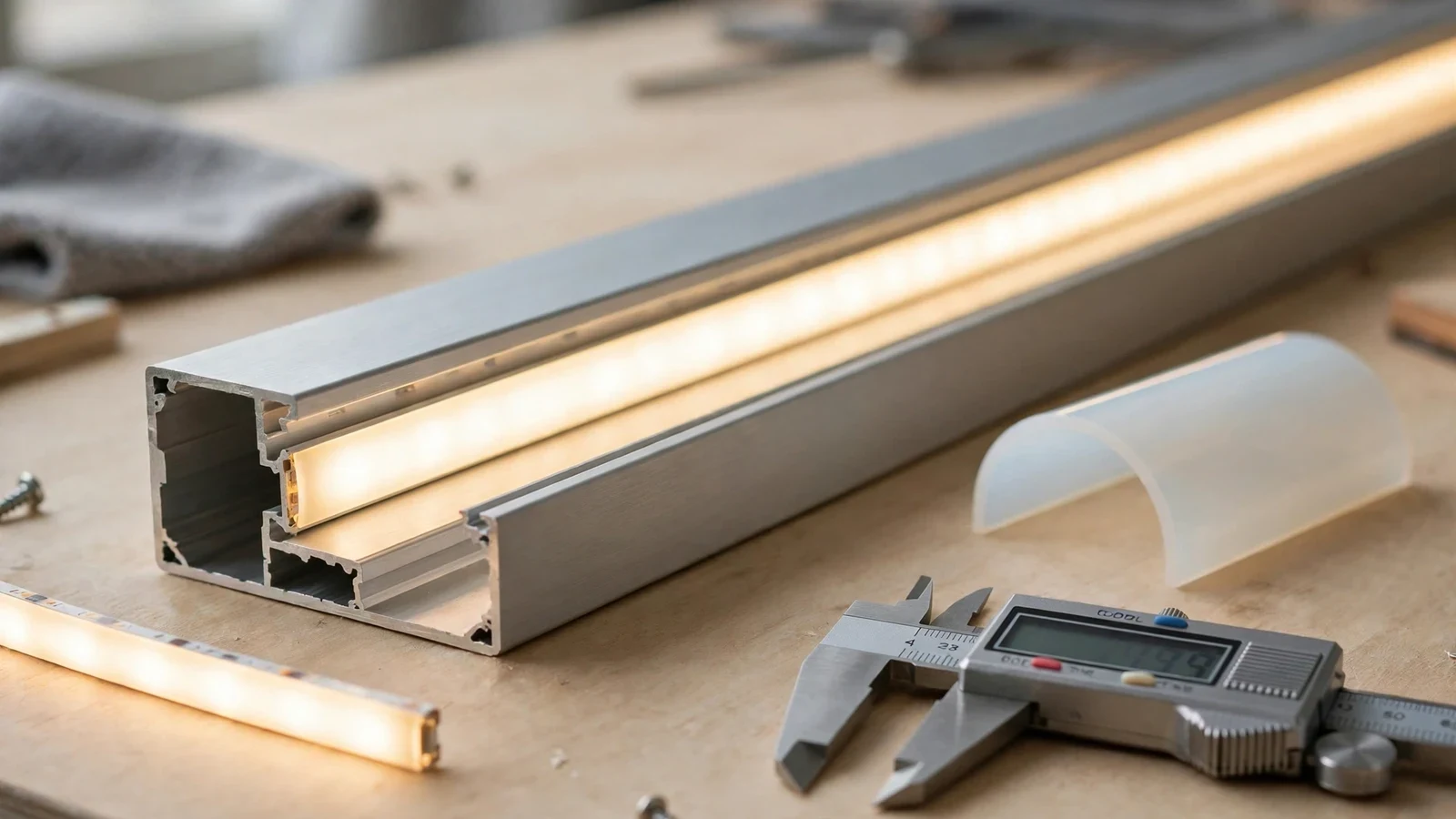
Fit has two parts: the strip must sit inside the profile channel, and the diffuser must sit far enough above the chips. When the diffuser sits too close, the light can show lines or bright spots instead of one smooth glow. Ask the profile supplier for the inner width and the diffuser height, then check both against the strip datasheet. A sample run on the bench will show the glow before you commit to a full order.
Deep profiles give the diffuser more room, so they suit visible runs where the glow must look even. Shallow profiles suit hidden runs, such as coves and toe kicks, where no one sees the strip itself. Match the profile depth to the install spot, and keep the same profile across one run for an even look. When two profiles look alike, compare their inner width drawings, because the outer size can hide a narrow channel.
Driver and Dimming Compatibility
A COB strip needs a driver that matches its voltage and dimming method, so confirm both before you order. Dimming works only when the driver and the strip use the same method, so check our dimming guide before you choose a driver. Ask the driver supplier for the voltage and the dimming method, then match them to the strip datasheet. A driver that cannot dim leaves the strip at full brightness, which suits some jobs and ruins others.
Buy the strip and the driver as a matched pair, and keep the same pair across one project for even light. Mixed drivers on one run can make some sections dim while others stay bright, so test the pair first. Keep one spare driver on site, because a failed driver can stop a whole run until a match arrives. Label each driver with its run, so a later swap never mixes two different pairs.
Common Mistakes to Avoid
Most COB orders fail on the same few errors, and each one is easy to avoid with a short check. Read the list below before you order, then run the five checks above against the datasheet. A ten-minute check now can save a full strip, a profile, and a return shipment later.
- Do not judge a strip by brightness alone, because a bright strip can still make colors look dull.
- Do not order from price alone, because a cheap strip with no datasheet can cost more in rework.
- Do not pick an IP rating by the number alone, because the install spot decides which rating fits.
- Do not skip the width check, because a strip that is too wide will not fit the profile at all.
Order one batch for one project, because strips from different batches can show a visible color shift. Ask the supplier to ship one batch, then check the batch code on each box when the goods arrive. When one batch cannot cover the job, keep each batch on its own run, so no run mixes two batches. A sample from the same batch will show the true color before the full order ships.
Ordering the Profile from NIUYUAN
NIUYUAN makes aluminum profiles only, and it does not supply LED strips, so order the strip and the profile from their own suppliers. Send the profile supplier the strip width and diffuser height, so the profile can be matched before it ships. Profiles use 6063-T5 aluminum alloy, and the factory runs six in-house extrusion lines. The factory covers 31,706 square meters, holds ISO 9001, RoHS, and CE marks, and serves North America, Europe, the Middle East, and Oceania.
The minimum order is 1,000 pieces, so plan the full run before you ask for a quote. Lead time runs 20–30 days from the prepayment date, while custom orders take 25–30 days and stock items ship in 3–7 days. New tooling takes about 7 days. Samples are free with freight collect, and standard samples take about 7 days. NIUYUAN has served more than 36,000 projects worldwide, so share your install spot and run length when you ask for a quote.
Before You Order
Work the five checks in order, keep the datasheet beside the order, and test a sample before the full run. A strip that passes all five checks will fit the profile, dim as planned, and show true colors on site. When any check has no answer, pause the order and ask the supplier. A late fix costs far more than a short wait.
Frequently asked questions
What should I check first before buying a COB LED strip?
Check the density on the product datasheet first, because density decides whether the light looks smooth. Then check the CRI value, the rated voltage, the IP rating, and the strip width against the profile inner width. A strip that passes all five checks will fit, dim as planned, and show true colors.
Do COB LED strips need a special aluminum profile?
A COB strip needs a profile whose inner width fits the strip width. The diffuser must sit far enough above the chips for an even glow. Deep profiles suit visible runs, while shallow profiles suit hidden runs such as coves. Measure the strip width on the datasheet, then compare it with the inner width on the profile drawing.
Can I dim a COB LED strip?
Yes, when the driver and the strip use the same dimming method. Confirm the rated voltage and the dimming method with the driver supplier, then match them to the strip datasheet. A driver that cannot dim leaves the strip at full brightness.
What IP rating does my COB strip need?
The install spot decides the rating, because a kitchen, a bathroom, and an outdoor cove face different water and dust risks. Read the IP code on the datasheet, and ask the supplier for the IP test result when the code is unclear.
Does NIUYUAN supply COB LED strips?
No. NIUYUAN makes aluminum profiles only and does not supply LED strips. The minimum order for profiles is 1,000 pieces, lead time runs 20–30 days from the prepayment date, and samples are free with freight collect. Send the strip width and diffuser height with your inquiry, so the profile can be matched before it ships.

Share this guide
Tell us what you need
Send Your Project Requirements
Share your contact details and tell us which LED profiles you need.
Explore custom profile options