
COB vs CSP vs SMD LED Strips Compared
COB, CSP and SMD LED strips look similar but light very differently. Compare packaging, light spots, heat and profile fit before you choose.
On This Page
COB, CSP and SMD are three ways to package the LEDs on a strip. They look similar on a reel, but they light a room in very different ways. SMD uses separate packaged chips spaced along the length of the strip. COB bonds bare chips straight onto the board and covers them with one layer of phosphor. CSP shrinks the package down to the size of the chip itself, with almost no extra material around it.
The package decides how the light looks, how heat leaves the strip, and which profile the strip needs. COB gives a smooth, dot-free line, while CSP gives a near-smooth line in a very compact form. SMD gives a row of separate points, so it needs more help from the profile and diffuser. Choose by the look you need, the space you have, and the budget you can spend.
How each package is built
SMD is the oldest of the three, and it is still the most common. Each LED chip sits inside its own small package, and the package is soldered onto a flexible circuit board. The packages sit apart from each other, so you can see the gaps between them when the strip is lit. Common package sizes include 2835 and 5050, and the size code names the package, not the brightness, so check the datasheet first.
COB takes a different path: bare LED chips are bonded directly onto the circuit board, with no separate package around each chip. One continuous layer of phosphor covers the whole row, so the strip glows as a single line. There are no gaps to see, and no single point of light stands out. The result is the smoothest light of the three, straight from the strip itself.
CSP is the newest of the three, and it is the most compact. The package is scaled down to the size of the chip, with no substrate and no wire frame around it. The chips bond directly to the board, so they sit closer together than SMD chips can. The strip stays slim, which suits narrow channels and tight spaces. CSP keeps the short heat path of COB while staying small enough for slim profiles and narrow channels.
COB vs CSP vs SMD at a glance
| Feature | SMD | COB | CSP |
|---|---|---|---|
| Packaging | Separate chips in small packages on a flexible board | Bare chips bonded to the board, one phosphor layer | Chip-scale package bonded straight to the board |
| Light spots | Visible dots unless a deep profile and opal diffuser hide them | Smooth, dot-free line | Small, faint dots, much less visible than SMD |
| Beam | Separate points of light, each with its own spread | Wide, even wash along the whole strip | Wide, even wash in a slim form |
| Heat path | Heat passes through the package, then the board | Short path from chip to board | Short path from chip to board |
| Cost position | Usually the lowest cost of the three | Usually the highest cost of the three | Between SMD and COB in most cases |
| Best use | General lighting and budget projects | Dot-free lines, retail, display, under cabinets | Slim channels, compact spaces, narrow profiles |
Read the table from the top down, not from one column alone. No package wins on every row, but SMD wins on cost and supply. COB wins on light quality, and CSP wins on size. Your project decides which row matters most. One widely read online comparison covers COB, CSP, SCOB and SOB, not SMD. Check which technologies a guide actually covers before you rely on it.
Matching each strip to a profile and diffuser
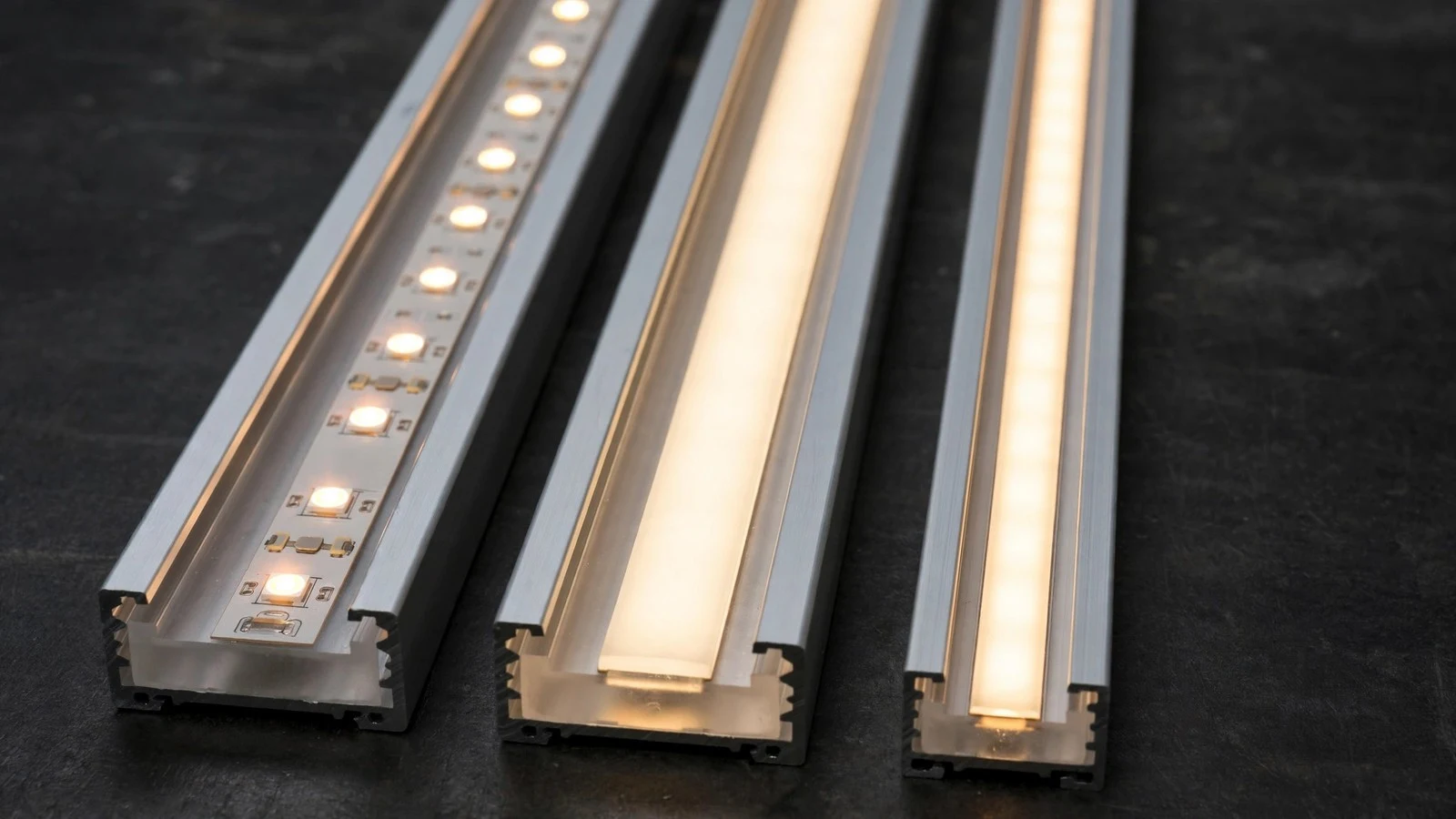
SMD needs the most help from the profile and the diffuser. The dots stay visible in a shallow profile with a clear cover, so pair SMD with a deeper channel and an opal diffuser. The depth gives the light room to blend, and the opal cover scatters the points into a line. A shallow surface profile can still work, but only with a thick opal diffuser and enough distance between the strip and the cover.
COB needs the least help, because the strip already gives a smooth line, so a shallow profile is often enough. Use a clear or opal diffuser mainly to protect the strip and soften the edge of the light. This makes COB a good fit for slim surface profiles and for places where the profile is on show. Our guide to 24V COB strip run length explains how far one run can go before voltage drop starts to show.
CSP sits between the two, and the dots are faint, so a medium-depth profile with an opal diffuser is usually enough. The slim strip fits narrow channels that a wider SMD board cannot enter. Check the strip width against the channel width before you order. A strip that is too wide for the channel cannot be fitted at all.
The diffuser material matters too, because the cover shapes the light you actually see. PC diffusers are tougher and suit profiles that may take a knock, while PMMA diffusers give a clearer light path. Our PC vs PMMA diffuser comparison explains the trade-off in full, so you can match the cover to the strip and the setting.
Heat: why the package changes the thermal path
Heat is the quiet factor in this choice. An LED turns part of its power into heat, and that heat must leave the strip through the board and into the profile. The package decides how far the heat must travel before it reaches the board. A long path traps more heat at the chip, and trapped heat wears the strip out sooner than a short path would.
SMD has the longest path, because heat passes through the package wall before it reaches the board. COB and CSP bond the chip straight to the board, so the path is short and the heat moves away fast. The profile still matters for all three, because the aluminum channel is the heat sink. A strip with good contact to a wide aluminum profile runs cooler than the same strip with poor contact in a narrow channel.
Which strip fits which project
Start from how the light will be seen, and if the strip is on show and the line must look smooth, choose COB. Retail shelves, display cases, mirrors, and under-cabinet runs all show the strip, so dots would spoil the effect. If the strip is hidden behind a pelmet or inside a cove, SMD is often enough, because nobody sees the strip itself. The profile and diffuser do the smoothing work out of sight.
Start from the space as well. A narrow channel, a slim trim, or a tight corner leaves little room for a wide board, so CSP is the natural fit. A deep recess with room for a wide profile suits SMD, because the depth hides the dots. Budget matters too, so SMD is the low-cost choice for large runs, and COB is the premium choice for visible lines. CSP sits between the two when space is tight.
How this guide differs from our other lighting guides
Two of our earlier guides cover part of this ground, but from a different angle. Our dot-free lighting guide explains how to remove dots from a strip you already have. Our diffuser guides explain how a cover can hide spots, and this guide compares the three packaging technologies themselves. Choose the right strip before you buy, instead of fixing the wrong one after it arrives.
Buying checklist
Use this checklist before you place an order, because the wrong package is hard to fix once the strips are installed on site.
- Ask the supplier to confirm the package type in writing: SMD, COB, or CSP.
- Check the strip width against the channel width of the profile you plan to use.
- Match the diffuser to the strip: choose opal for SMD, and lighter covers for COB.
- Check the profile depth: SMD needs depth, while COB works well in shallow profiles.
- Ask for the color temperature and CRI of the exact strip, on the datasheet.
- Order a sample, and test it in the actual profile and diffuser before you order in bulk.
- Confirm the driver and power supply separately, because the profile supplier does not provide them.
- Order all strips for one project from the same batch, so the color stays even.
Ordering LED aluminum profiles from NIUYUAN
NIUYUAN is a LED aluminum profile manufacturer founded in 2012, with 6 in-house extrusion lines and OEM/ODM support. The factory covers 31,706 m², and profiles are made from 6063-T5 aluminum alloy, and the company holds ISO 9001, RoHS and CE certification. NIUYUAN supplies the aluminum profile, not the LED strip or the driver, so strips and power supplies are sourced separately.
The minimum order quantity is 1000 pieces. Lead time is 20–30 days from prepayment, and in-stock profiles ship in 3–7 days, while custom profiles take 25–30 days. New tooling takes about 7 days, and standard samples take about 7 days, and samples are free with freight collect. For custom lengths or profiles, see our custom LED aluminum profiles page.
FAQs
What is the main difference between COB, CSP and SMD LED strips?
The package is the main difference. SMD uses separate packaged chips spaced along the strip, so you can see dots. COB bonds bare chips to the board under one phosphor layer, so the light is a smooth line. CSP shrinks the package to chip size, so the strip is slim and the dots are faint.
Which LED strip type has no light spots?
COB has no visible light spots, because the chips sit under one continuous phosphor layer. CSP comes close, with only faint dots. SMD shows clear dots unless a deep profile and an opal diffuser hide them.
Do COB strips need a diffuser?
COB strips work well with a light diffuser or none at all, because the light is already smooth. A diffuser still helps, because it protects the strip and softens the edge of the light. Choose the cover for protection and looks, not to hide dots.
Which strip should I choose for under-cabinet lighting?
COB is the usual choice for under-cabinet lighting, because the strip is on show and the line must look smooth. CSP suits slim cabinets with narrow channels. SMD can work too, but only in a deep profile with an opal diffuser that hides the dots.
Does NIUYUAN supply COB, CSP or SMD LED strips?
No. NIUYUAN makes LED aluminum profiles, not LED strips or drivers. Strips and power supplies are sourced separately. NIUYUAN supplies the profile that holds the strip, cools it, and shapes the light.
Frequently asked questions
What is the main difference between COB, CSP and SMD LED strips?
The package is the main difference. SMD uses separate packaged chips spaced along the strip, so you can see dots. COB bonds bare chips to the board under one phosphor layer, so the light is a smooth line. CSP shrinks the package to chip size, so the strip is slim and the dots are faint.
Which LED strip type has no light spots?
COB has no visible light spots, because the chips sit under one continuous phosphor layer. CSP comes close, with only faint dots. SMD shows clear dots unless a deep profile and an opal diffuser hide them.
Do COB strips need a diffuser?
COB strips work well with a light diffuser or none at all, because the light is already smooth. A diffuser still helps, because it protects the strip and softens the edge of the light. Choose the cover for protection and looks, not to hide dots.
Which strip should I choose for under-cabinet lighting?
COB is the usual choice for under-cabinet lighting, because the strip is on show and the line must look smooth. CSP suits slim cabinets with narrow channels. SMD can work too, but only in a deep profile with an opal diffuser that hides the dots.
Does NIUYUAN supply COB, CSP or SMD LED strips?
No. NIUYUAN makes LED aluminum profiles, not LED strips or drivers. Strips and power supplies are sourced separately. NIUYUAN supplies the profile that holds the strip, cools it, and shapes the light.

Share this guide
Tell us what you need
Send Your Project Requirements
Share your contact details and tell us which LED profiles you need.
Explore custom profile options