
What Is an LED Strip Light?
Learn what an LED strip light is, its parts and types, and how it fits an aluminum profile. A clear buyer guide from NIUYUAN.
On This Page
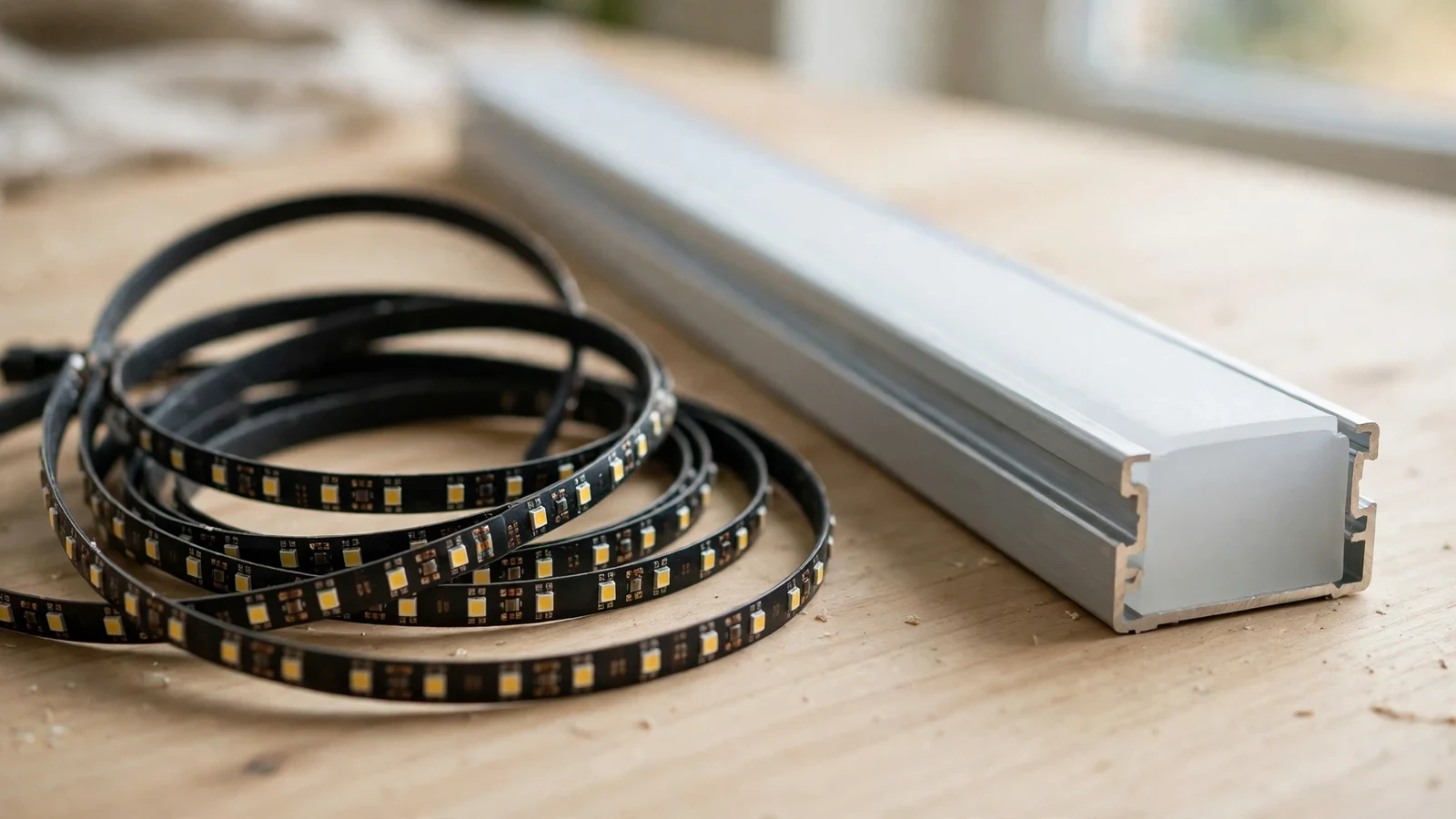
An LED strip light is a flexible circuit board with light-emitting diodes, resistors and other parts mounted on it. It produces continuous linear light from low-voltage DC power. Inside an aluminum profile, the profile cools it, holds its shape and hides the light source. This guide explains the parts, the main types and the way a strip works inside a profile.
Buyers meet strip lights in many places, from kitchen cabinets and stair edges to mirrors and retail shelves. A buyer who knows the parts and the types can ask sharper questions when the strip must fit a metal profile. The sections below cover parts, types, control and the fit with a profile. A clear picture of the strip also makes the later profile choice easier, since size and shape follow the strip.
The question sounds basic, yet it guides real orders and shapes the parts a buyer must check. A buyer who confuses a strip with a finished lamp may order the wrong driver for the job. A buyer who skips the profile may watch the strip overheat and fade long before its time. This guide keeps the focus on the strip itself, while profile choice, fitting steps and chip detail live in the linked guides.
Many buyers first meet a strip as a roll in a box, with no sign of what sits inside it. The roll hides the diodes, the resistors and the wiring under a flat surface. This guide opens that roll in words, so the buyer can see each part and each type before ordering. Each part has a job, and each type fits a different room.
What Are the Parts of an LED Strip Light?
A strip light looks simple from the outside, yet five parts work as one unit inside the board. The base is a flexible printed circuit board that carries power along the strip and holds each part in place. Small light-emitting diodes sit on the board in a row, with resistors beside them to limit the current. An adhesive back sticks the strip to a surface, and a thin coating guards the parts from dust and touch.
- Flexible circuit board: the thin base that carries power and holds the diodes and resistors in a straight line.
- LEDs: the light source, with each diode turning power into light as the diodes sit close together to form a line.
- Resistors: small parts that limit current through each group of diodes, so the light stays even along the run.
- Adhesive backing: the sticky layer on the rear that fixes the strip to a flat surface.
- Protective coating: a thin layer over the parts that guards against dust and light touch.
The parts depend on each other, so one weak link can spoil the whole strip. A weak board bends or breaks the circuit, and a missing resistor lets too much current reach the diodes. Poor adhesive lets the strip lift from its base, which breaks the clean line the buyer wanted. A buyer does not need to test each part alone, but should know what each part does and check both datasheets before ordering.
Most strips also carry cut marks at set gaps, and a buyer cuts only at those marks. Each cut leaves a working section, with solder pads beside each mark for joining lengths or adding a lead. The gap between marks depends on the strip design, so check the datasheet for the cut spacing first.
Types by Colour
Colour is the first choice most buyers make, and each type suits a different kind of room. A single colour strip gives one fixed colour, such as warm white or cool white, for steady task light. A tunable white strip shifts between warm and cool white, while an RGB strip mixes red, green and blue to make many colours. An RGBW strip adds a white diode to the mix for cleaner white light, as the table below shows.
| Type | What it gives | Where it fits best |
|---|---|---|
| Single colour | One fixed colour | Kitchens, shelves, task light |
| Tunable white | Warm to cool white | Offices, living rooms, hotels |
| RGB | Many mixed colours | Signs, bars, feature walls |
| RGBW | Colour plus clean white | Homes, shops, display light |
Start with the room, not the strip, since warm white suits bedrooms and dining areas while cool white suits worktops and offices. Colour changing light suits display and leisure spaces, so match the colour to the mood of the room first. A buyer who picks colour first can then match the package and the control to the same plan. The room sets the tone, so let its daily use lead the colour choice from the start.
Types by Chip Package
The chip package shapes how the light looks, since each package places the light in a different way. SMD strips place separate diodes on the board, so each point of light stays visible along the run. COB strips pack many tiny chips close together under one coating, so the line looks smooth with no dots. CSP strips use a compact package with no separate frame, and our guide to COB, CSP and SMD strips compares the three packages.
| Package | How it looks | Common use |
|---|---|---|
| SMD | Separate points of light | General lighting, signs |
| COB | Smooth line, no dots | Shelves, coves, display |
| CSP | Compact, bright points | Slim profiles, tight spaces |
No package is best for every job, so match the package to the look and the space you have. SMD suits buyers who want a known, widely used form, while COB suits buyers who want a smooth line with no visible dots. CSP suits slim profiles where space is tight, so check the profile inner width before you order. Check the strip datasheet for the package type as well, since the control type is the next choice.
Types by Control
Control decides how the light changes, since a standard strip lights the whole run as one unit. One controller sets brightness or colour for the full length, while an addressable strip controls small groups one by one. That control allows running effects and colour waves along the strip, so the choice depends on the effect the buyer wants. A buyer who wants one steady look can keep the control simple and change little after fitting.
Controllers and drivers sit outside the profile, and NIUYUAN makes aluminum profiles only, not strips, drivers or controllers. Buyers source the strip, driver and controller from their own suppliers, so the choice stays with the buyer. Check that the driver voltage matches the strip voltage and that the controller type fits the strip type, using the datasheets for the figures.
Dimming changes the mood of a room, since a basic dimmer lowers the brightness of the whole run at once. A colour controller changes the mix on RGB and RGBW strips, while an addressable controller sends signals to each group. Match the controller to the strip type, match the driver power to the full run length, and read both figures from the datasheets.
How a Strip Fits Inside an Aluminum Profile
A strip on its own is soft and open to damage, yet inside a profile it gains a firm base and a clean finish. The profile also spreads heat away from the diodes, which helps the strip run cooler over long hours. A buyer who plans the strip and the profile together avoids most fit problems before they start. Our guide to choosing an LED aluminum channel explains how to match profile size and shape to the job.
- Cooling: the metal body draws heat away from the diodes, which helps the strip run cooler over long hours.
- Shape: the profile holds the strip straight, so the line stays even along walls, shelves and ceilings.
- Hiding the source: a diffuser over the profile softens the light and hides the diodes, so the eye sees a line, not dots.
A diffuser changes the look of the finished line, since a clear cover keeps the light bright and shows each diode. A frosted cover softens the light and hides the diodes, which suits living and retail spaces best. Our installation guide shows how to fit a strip into an aluminum channel step by step. A frosted cover also spreads the light wider across the room, so fewer bright spots reach the eye.
Matching a Strip to a Profile
Fit is a matter of width and length, since the strip must sit flat inside the profile channel with room to spare. The profile inner width must clear the strip width, and the strip length must match the profile length. Our guide to the best LED aluminum channel compares profile types for common jobs.
Buyer Checklist
- Confirm the strip voltage and match it to the driver voltage.
- Confirm the chip package and the look it gives.
- Measure the strip width and check the profile inner width.
- Check the strip length against the profile length.
- Check the IP rating if the strip goes near water.
- Read the strip and profile datasheets before you order.
Indoor and outdoor use differ, since a dry indoor strip needs no extra sealing at all. A strip near water needs a rated coating and a sealed end, so match the IP rating to the room. Seal the profile ends where water may reach them, and keep dust cover on open runs even in a dry room. A damp room needs the same care, even when no water touches the strip itself or the profile ends.
What to Ask Before You Order
NIUYUAN supplies the aluminum profile, not the strip, and the profile range uses 6063-T5 alloy. The range runs on six in-house extrusion lines, and the factory covers 31,706 square metres of floor space. The team holds ISO 9001, RoHS and CE certification. Orders start at 1,000 pieces, with lead time of 20 to 30 days from prepayment. Samples are free, with freight collect, and standard samples take about 7 days.
A strip light is easy to buy and easy to fit badly, so plan the strip, the profile and the control as one system. Start with the colour and the package, then match the width, the voltage and the datasheet figures to the plan. A short check against the list above saves a second order and a second round of fitting. That short check turns a guess into a plan the buyer can trust before the order goes in.
Frequently asked questions
What is an LED strip light?
It is a flexible circuit board with diodes, resistors and other parts mounted on it. It gives continuous linear light from low-voltage DC power. Inside a profile, the profile cools it, holds its shape and hides the source.
Do LED strip lights need an aluminum profile?
No, but a profile helps in most fixed jobs. It cools the strip, holds it straight and hides the diodes behind a diffuser. High power runs gain the most from a profile. Check the strip and profile datasheets for the fit.
What voltage do LED strip lights use?
Most strips run on low-voltage DC power. Always read the strip datasheet for the exact voltage. Match the driver voltage to the strip, and size the driver for the full run length.
What is the difference between SMD and COB strips?
SMD strips show separate points of light along the board. COB strips pack tiny chips close together, so the line looks smooth with no dots. CSP strips use a compact package for slim spaces. The choice depends on the look you want.
Can I cut an LED strip to length?
Yes, but cut only at the marked cut points. Each cut leaves a working section with solder pads for joins. Check the strip datasheet for the cut spacing before you plan the run.

Share this guide
Tell us what you need
Send Your Project Requirements
Share your contact details and tell us which LED profiles you need.
Explore custom profile options