
How to Choose LED Profiles for Outdoor and Wet Areas
Learn how to choose LED profiles for outdoor and wet areas: define the exposure, read the IP rating correctly, and check seals, materials, and documents.
On This Page
An aluminum profile is not automatically waterproof, and a waterproof strip inside an ordinary channel does not make a waterproof system. The right profile for an outdoor or wet area is the one whose whole assembly, seals, and documents match the actual exposure. Start from the exposure, not from the word waterproof on a product page.
This guide works through the choices that decide the result. They are the exposure, the IP rating, the seals and cable entries, the materials, and the documents to request. It ends with an exposure table and a checklist to run before you order. Use it to shortlist profiles, then confirm the final choice against the section drawing, the rating documents, and a sample.
This guide covers outdoor facades, covered terraces, bathrooms, kitchens, and washdown areas. It does not assign an IP rating to any NIUYUAN profile. A rating belongs to a documented assembly and configuration, not to a bare channel. Use it to write a better brief, then confirm the rating for your exact assembly.
01. Define the exposure before you choose
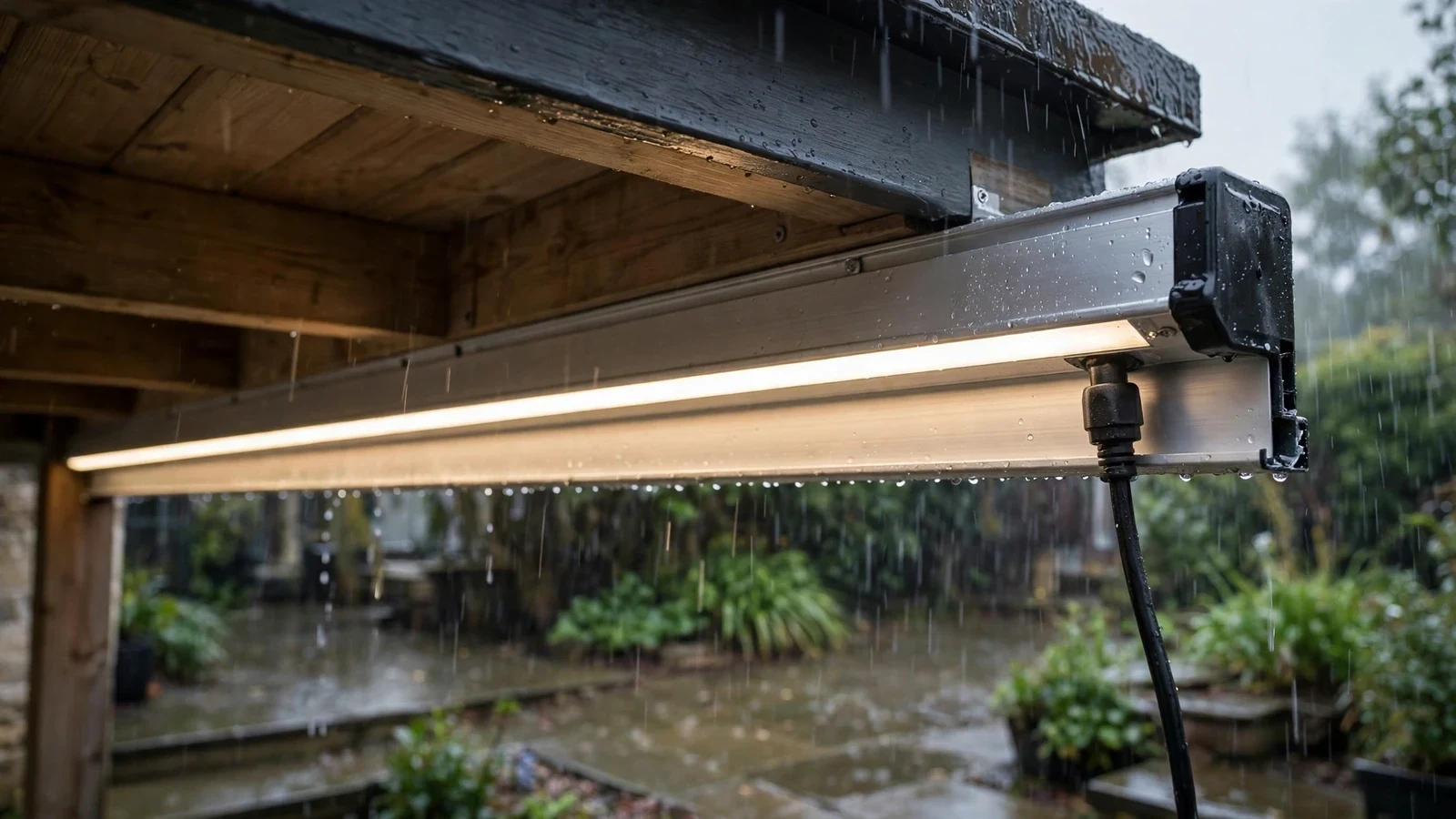
Outdoor is a starting point, not a specification: a covered terrace edge faces wind-driven rain, while an open facade faces direct rain and sun. A bathroom wall faces splashes and steam, while a washdown area faces cleaning jets and chemicals. Each exposure stresses different parts of the assembly, so each one needs a different brief.
Write down the water source, the direction, and the duration for each run. Note whether the water arrives as rain, splash, condensation, or cleaning spray. Note whether the run sits under cover, on an open wall, or near the ground where water can stand. These notes decide which rating and which seals are even relevant.
Do not forget condensation, sunlight, and temperature. Water can form inside an assembly when warm, humid air meets a cold surface, even where no rain reaches it. Sunlight and heat age covers and seals over time, and cleaning chemicals attack some materials faster than others. A brief that names only rain will miss half the exposure.
02. Read the IP rating correctly
An IP code describes how an enclosure resists solids and water under defined test conditions. The first digit concerns solids and access, while the second concerns water. IEC 60529 is the principal standard behind these codes. A code is not a general promise that a product suits every outdoor condition, cleaning chemical, or service life.
The water digits are not interchangeable shorthand. IPX5 relates to water jets, IPX7 to temporary immersion, and IPX8 to immersion under agreed conditions. A higher number does not automatically cover every different exposure, and a rating for one configuration does not transfer to a changed assembly. Ask for the test conditions behind any code you rely on.
A strip rating is not an assembly rating. A coated strip may carry its own rating, while the profile, the connectors, the driver, and the cable entries have separate requirements. Our waterproof and IP rating guide explains this split in detail. Read it before you treat a strip rating as a system rating. The finished assembly is what must survive the exposure.
03. Seals, end caps, and cable entries decide the result
Water enters through interfaces, not through solid aluminum. The cover joint, the end caps, the cable entries, and the joints between sections are the paths that matter. A channel body can be perfect while the assembly still leaks at an end cap or a cable hole. Review each interface on its own terms before you approve the assembly.
End caps deserve special attention, because a cap that looks finished may not seal at all. Confirm the exact cap reference, whether a seal is included, how the cable exits, and whether the cap can be removed and refitted. A cap replaced with an unapproved alternative may not preserve the intended condition, so record the approved cap in the order.
Cable entries need the same care. A hole added on site changes the assembly and may void the protection it was bought for. The responsible designer should specify the entry position, the cable protection, and the sealing method. Do not assume that filling a hole with an unspecified sealant preserves a rating claimed for the original assembly.
04. Materials and finishes outdoors
Aluminum suits outdoor use, but the finish and the cover still need review. Anodizing and powder coating protect the surface, and the agreed finish reference should be recorded for the order. Salt air, cleaning chemicals, and standing water attack finishes at different rates, so name the environment when you discuss the finish.
Diffuser material matters outdoors for a different reason. A cover chosen for indoor appearance may yellow, craze, or loosen under sun and temperature change. Ask for documentation on the proposed cover material and grade, not just its color name. The diffuser range lists the cover options, and the fit must be confirmed for the exact section.
Check the whole assembly for temperature range, not just the profile. Covers, seals, adhesives, and drivers each have their own limits, and the weakest one sets the limit for the run. A profile that survives a cold night may still fail when its seal hardens and shrinks. Ask the supplier to confirm the range for the complete assembly.
05. Heat, condensation, and enclosed runs
Heat behaves differently outdoors than on a test bench. A channel in open air sheds heat well, while the same channel inside an enclosed soffit or behind a fascia traps it. The strip, the mounting interface, the cover, and the surrounding construction all shape the final temperature. Use the strip maker's requirements, and check the assembly in its real mounting arrangement.
Condensation is the quiet failure in outdoor and wet areas. Warm, humid air inside a sealed assembly can condense when the temperature falls, and the water then sits against the strip and the connections. An IP code alone does not show that condensation is controlled. Discuss venting, sealing, and the operating cycle with the responsible designer before you approve a sealed run.
Enclosed runs need a maintenance plan as well as a rating. Ask how the cover comes off, how the strip is replaced, and how the seals are remade after service. A run that cannot be opened and resealed correctly will lose its protection at the first service visit. Record the service method with the order, not after the installation.
06. Exposure-to-brief table
Use this table to turn an exposure into a brief, with each row naming a common exposure, the first question, and the document to request. The table sets the brief; it does not assign a rating to any profile.
| Exposure | First question to ask | Document to request |
|---|---|---|
| Covered terrace, wind-driven rain | Which assembly carries the rating? | Rating scope and test conditions |
| Open facade, direct rain and sun | Which cover and seal suit UV and rain? | Cover material and seal data |
| Bathroom splash zone | Which interfaces are sealed? | End cap and cable entry detail |
| Washdown area, cleaning jets | Which jet conditions were tested? | Test report for the exact assembly |
| Cold nights, humid air | How is condensation handled? | Assembly design and service method |
When no standard section fits the exposure, a custom profile can close the gap. Share the exposure brief, the drawing, and the strip data with the supplier, and agree the section, the seals, and the component list before production. Custom work suits unusual exposures, but it needs the same documents as a standard section.
Two cautions apply to the whole table. First, a rating claimed for one configuration does not transfer to a changed assembly, so recheck the documents after any change. Second, the installer and the designer share responsibility for the finished assembly, so keep the agreed scope in writing.
07. Selection checklist
Run through this list with your exposure brief, your strip data, and your section drawing in hand. Every item needs an answer before the order goes out; any gap is a question for the supplier, the designer, or the installer.
- Exposure defined: source, direction, duration, and cleaning
- IP code understood, with test conditions requested
- Strip rating separated from assembly rating
- End caps, seals, and cable entries specified
- Cover material and finish checked for UV and chemicals
- Condensation and service method discussed
- Rating documents tied to the exact assembly
- Sample reviewed in the real mounting arrangement
With the exposure brief, the rating documents, and this checklist, you can compare profiles on evidence instead of on the word waterproof. That comparison is what keeps an outdoor lighting detail from failing in its first wet season. Keep the brief and the documents with the order, so a later reorder starts from the same facts.
Frequently asked questions
Is every aluminum LED profile waterproof?
No: an aluminum channel with a snap-in diffuser is not automatically a sealed, rated enclosure. Review the complete assembly and the documents that apply to its exact configuration.
Does an IP65 strip make the whole assembly IP65?
No: the strip rating applies to the strip under its own conditions. The profile, the connectors, the driver, and the cable entries need their own review, and the finished assembly is what must survive.
What about condensation inside a sealed profile?
Condensation can form when warm, humid air meets a cold surface inside the assembly. An IP code alone does not show that it is controlled. Discuss the design, the operating cycle, and the service method with the responsible designer.
Can I use an indoor profile under a covered terrace?
Only when the documented assembly suits that exposure. A covered spot still faces wind-driven rain, humidity, and temperature change. Ask for the rating scope and the test conditions before you approve it.
What documents should I request for a wet-area order?
Request the rating scope, the test conditions, the end cap and cable entry details, and the cover material data, all tied to the exact assembly. A report for a different product or a modified assembly may not support the claim you need.

Share this guide
Tell us what you need
Send Your Project Requirements
Share your contact details and tell us which LED profiles you need.
Explore custom profile options