
Why Extrusion Thickness Matters for LED Heat
Thicker profile walls spread heat better and stay straighter, but they cost more. Learn how wall thickness trades off against heat, rigidity, and install.
On This Page
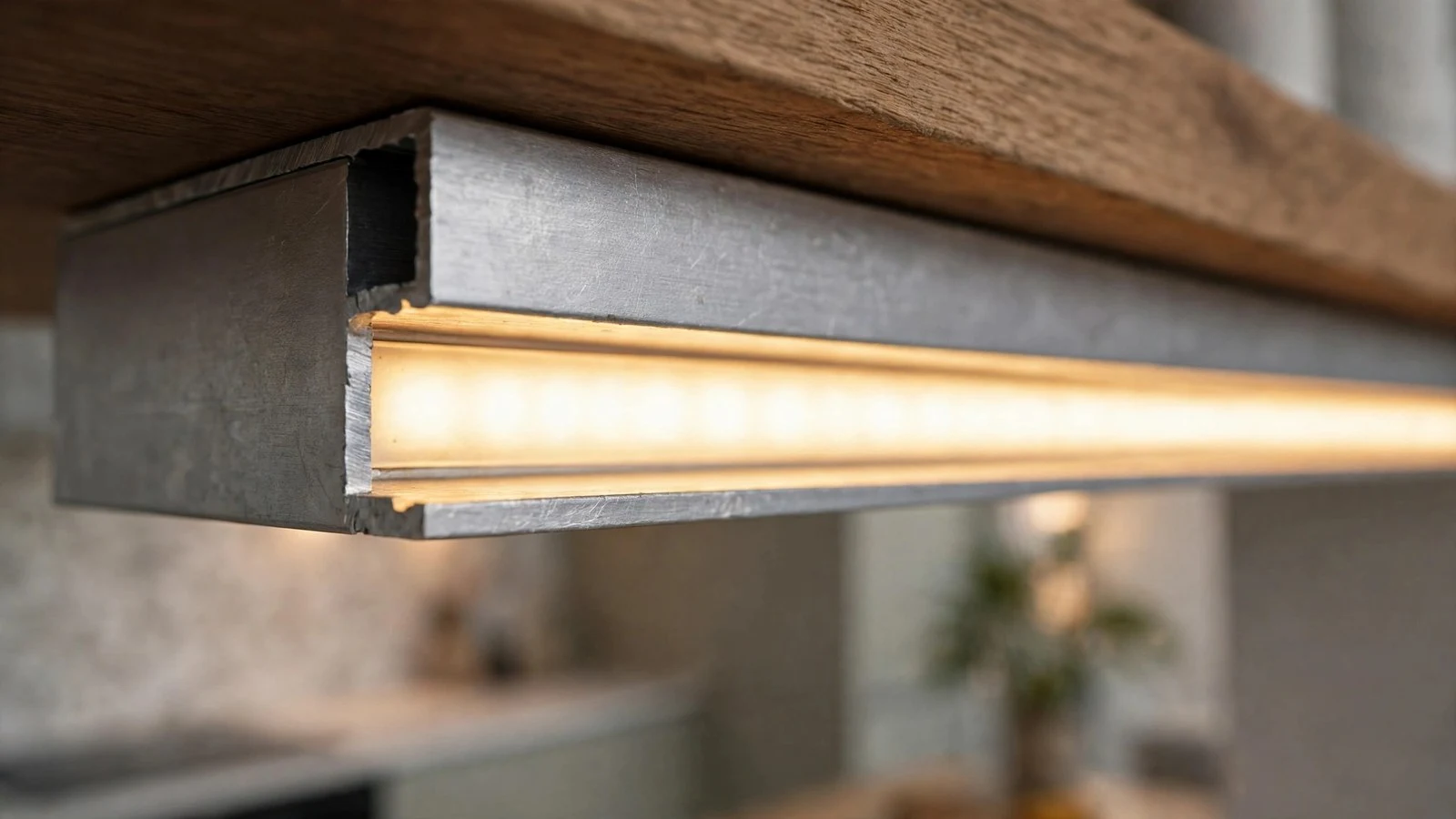
Extrusion thickness is the wall thickness of an LED aluminum profile. It sets how well the profile spreads heat, resists bending, and fits its mount. A thicker wall gives heat more metal to travel through, so warmth spreads along the channel. The same wall also makes the profile stiffer, so it holds a straight line over a long span.
This article answers one question: how does that single variable change heat, rigidity, and install, and what trade-offs follow? The answer matters because a profile that runs hot shortens strip life, while a profile that bends ruins a clean line of light. Buyers often pick thickness by habit, or by one vendor number. Neither habit is a spec, so read on to see how thickness works, where it helps, and where it stops helping.
How a thicker wall moves heat
An LED strip turns part of its power into heat, and that heat starts under the strip. The aluminum channel acts as a heat sink, pulling warmth away from the strip and spreading it across a wider surface. A thicker wall offers a wider path for that heat, so the strip runs cooler and more evenly. A thin wall can still work, but it has less metal to carry the heat away.
The alloy matters as much as the wall. NIUYUAN profiles use 6063-T5 aluminum alloy, and this alloy conducts heat at about 200 W/m·K, a general value. That figure is a property of the alloy, not of one model, so check the data sheet for the exact value. A thick wall in a poor alloy will not beat a thin wall in a good one. Ask for the alloy and the temper first, then ask about the wall.
Surface area sets the second limit: heat must leave the metal, and a wider base or a finned shape gives it more room to escape. A thick wall with a narrow base can still trap heat. Mounting changes the picture again: a channel pressed against a surface loses heat into that surface, while a gap lets air flow around it. Judge the whole shape and install, not the wall alone.
What thickness does to rigidity
Rigidity is the second job of the wall, and it shows up during install and over time. A thin, open profile flexes when you lift it, clip it, or press a diffuser into place. That flex shows most on a long length, where the middle sags between supports. A thicker wall resists that flex, so the line stays straight from end to end, and the effect grows with length. Long runs repay a stiffer wall.
Heat cycles add a slow test: a channel warms up when the strip runs and cools down when it switches off. Each cycle pushes the metal to expand and shrink. A stiff wall holds its shape through those cycles, while a weak wall can take a permanent bend. Fixed mounts raise the risk, because the metal has nowhere to grow. Leave room for expansion, and a modest wall can survive cycles that would bend a fixed thin one.
Long runs deserve the most care: length multiplies both heat and flex. A long strip run builds heat, and a long channel has more span to sag. Our guide to how run length affects heat in a 24V COB strip explains the voltage and heat side of long runs. Check the run length first, then match the wall and supports to it. For a suspended run, add a support plan first: a hanging channel has no surface to lean on.
The three-way trade-off
Thickness trades heat and rigidity against cost, weight, and install effort. Every extra bit of wall adds metal, and metal adds cost per meter and weight per length. A heavier channel needs stronger mounts and more care in handling. A thicker wall can also limit how tight a bend the profile can take. The table below shows the trade in one view, so you can weigh each side before you choose.
| What changes | Thinner wall | Thicker wall |
|---|---|---|
| Heat spreading | Less metal to carry heat away | More metal to spread heat along the channel |
| Rigidity | Flexes more on long spans | Holds a straight line on long spans |
| Cost per meter | Lower, less metal per meter | Higher, more metal per meter |
| Weight and handling | Lighter, easier to lift and fit | Heavier, needs stronger mounts |
| Install fit | Fits tight spaces and shallow recesses | Needs more depth and stronger fixings |
No row wins on its own: the right choice depends on power, length, and install. A low-power strip on a short run needs little heat spreading or stiffness, so a thin wall is enough. A high-power strip on a long suspended run needs both, so the extra metal earns its cost. Between those cases, check each variable in turn, and let the hardest one set the wall. The next section shows why vendors disagree on the numbers.
Why thickness numbers disagree
Guides quote different thickness numbers, and they cannot all be right. One guide may call a thin wall risky, while another calls the same wall fine. A third may name another minimum for the same power. Each number comes from a different test, shape, and install, so the numbers do not transfer from one guide to the next. Treat any thickness number as a vendor suggestion, not a standard, and ask what test and install sat behind it.
Compare by the data sheet, not the headline. Ask the supplier for the wall thickness and tolerance, the alloy and temper, and any thermal test data for that model. With no test data, ask for a finished sample and test it in your own install. A sample tells you more than a number in a guide, because it shows how the model behaves in your setting. Keep the answers in writing.
How to choose thickness by scenario
Use the checklist below to match the wall to your scene, and start with the hardest variable in your install. Plan for the harder one if two scenes apply at once, and check the supports at the same time.
- Low-power strip, short run. A thin wall is usually enough, because heat and flex stay small. Spend the budget on a good diffuser instead.
- High-power strip, long run. Choose a thicker wall with a wide base, and add supports along the span. Check the run length and the heat path before you order.
- Suspended install. Rigidity matters most, because the channel hangs with no surface behind it. Add a support plan and confirm the mounts can carry the weight.
- Outdoor or hot setting. Heat and weather work together, so confirm the alloy, the wall, and the sealing in one spec. Test a sample in the real setting first.
For the install itself, our guide to installing an LED strip in an aluminum channel covers mounting, spacing, and air flow. Read it before you fix the channel in place, because a good wall cannot rescue a bad mount. Check the supports, the end gaps, and the air path in one pass, and the channel will hold its line.
How this article differs from our heat guides
We already publish a guide on heat and LED channels. Our heat management guide for LED aluminum channels explains how to specify the right channel for heat. It covers thermal design and temperature measurement in a real install. That guide is about choosing a channel that runs cool, while this article is about one variable only. It asks what wall thickness does to heat, rigidity, and install, and what trade-offs follow.
Our article on how hot an extrusion can get before it warps answers a second nearby question. It asks how hot a profile must get before it warps, and whether an LED strip can ever get it there. Read the heat guide when you pick a channel, and read the warping article when someone asks whether the channel will bend. Read this article when you must choose the wall.
Questions to ask before you order
Ask these questions before you place an order, because the answers decide which wall fits your install. Write the answers into the order, so the factory and the buyer agree on the same spec. A supplier who cannot answer has not tested the profile.
- What is the wall thickness and tolerance of this exact model?
- Which alloy and temper is it, and can you send the data sheet?
- What thermal test data exists for this model, and at what power level?
- How should the mounts and supports allow for expansion?
- What is the longest span this model can hold without extra support?
- Can you send a finished sample, so I can test the fit and the heat?
Ordering LED aluminum profiles from NIUYUAN
NIUYUAN is a LED aluminum profile manufacturer founded in 2012, with 6 in-house extrusion lines and OEM/ODM support. The factory covers 31,706 m², and profiles are made from 6063-T5 aluminum alloy. The company holds ISO 9001, RoHS and CE certification, and it exports to North America, Europe, the Middle East and Oceania. NIUYUAN supplies the aluminum profile, not the LED strip or the driver, so strips and power supplies are sourced separately.
NIUYUAN has completed more than 36,000 projects around the world, and the minimum order quantity is 1000 pieces. Lead time is 20–30 days from prepayment, and in-stock profiles ship in 3–7 days, while custom profiles take 25–30 days. New tooling takes about 7 days, standard samples take about 7 days, and samples are free with freight collect.
For your order, confirm the alloy, the wall thickness, and the mounting method, and ask for a finished sample before you commit. Test it in the real install, and for custom lengths or profiles, ask the sales team for the data sheet.
Frequently asked questions
Does a thicker LED profile wall always run cooler?
Not always. A thicker wall spreads heat better, but surface area, alloy, and mounting matter too. A thick wall with a narrow base can still trap heat, while a thinner wall with a wide base can run cooler. Judge the whole shape and install, not the wall alone.
What wall thickness should I choose for a high-power LED strip?
There is no single standard thickness, because vendor guides disagree and each number assumes a different test and install. Ask the supplier for the wall thickness and tolerance of the exact model, plus thermal test data. Test a finished sample at your power level before you order in bulk.
Can a thin LED profile bend or warp?
Yes, a thin, long profile can flex during install and bend over time, mostly when heat cycles and fixed mounts stack together. Shorten the span, add a support, or choose a thicker wall for long runs. Leave room for expansion at the ends.
Does wall thickness affect the cost of an LED profile?
Yes. A thicker wall uses more metal, so it costs more per meter and weighs more. It also needs stronger mounts and more care in handling. Choose the thinnest wall that still meets your heat and rigidity needs.
Does NIUYUAN offer profiles in different wall thicknesses?
NIUYUAN can discuss profile options for a selected model, including the alloy, the wall thickness, and the mounting method. The right choice depends on your install, so confirm the details in writing and ask for a finished sample before you commit.

Share this guide
Tell us what you need
Send Your Project Requirements
Share your contact details and tell us which LED profiles you need.
Explore custom profile options