
Flexible LED Wall Washers for Curved Facades
Choose a flexible LED wall washer for a curved facade by bending method and beam angle first. Compare chain modules and silicone bodies.
On This Page
For a curved facade, the key question is not how bright the light is. It is whether the fixture can follow the curve, and whether the light patches join into one even wash. A flexible LED wall washer is a lighting fixture built to bend along a curve. It washes a facade with light from a short distance, instead of lighting a room, and this guide explains how to select one.
Start with the bending method and the beam angle, then check the control protocol and the outdoor protection. Each step below covers one choice, in the order you should make it. The guide stays with selection only, and it states no vendor numbers without a datasheet.
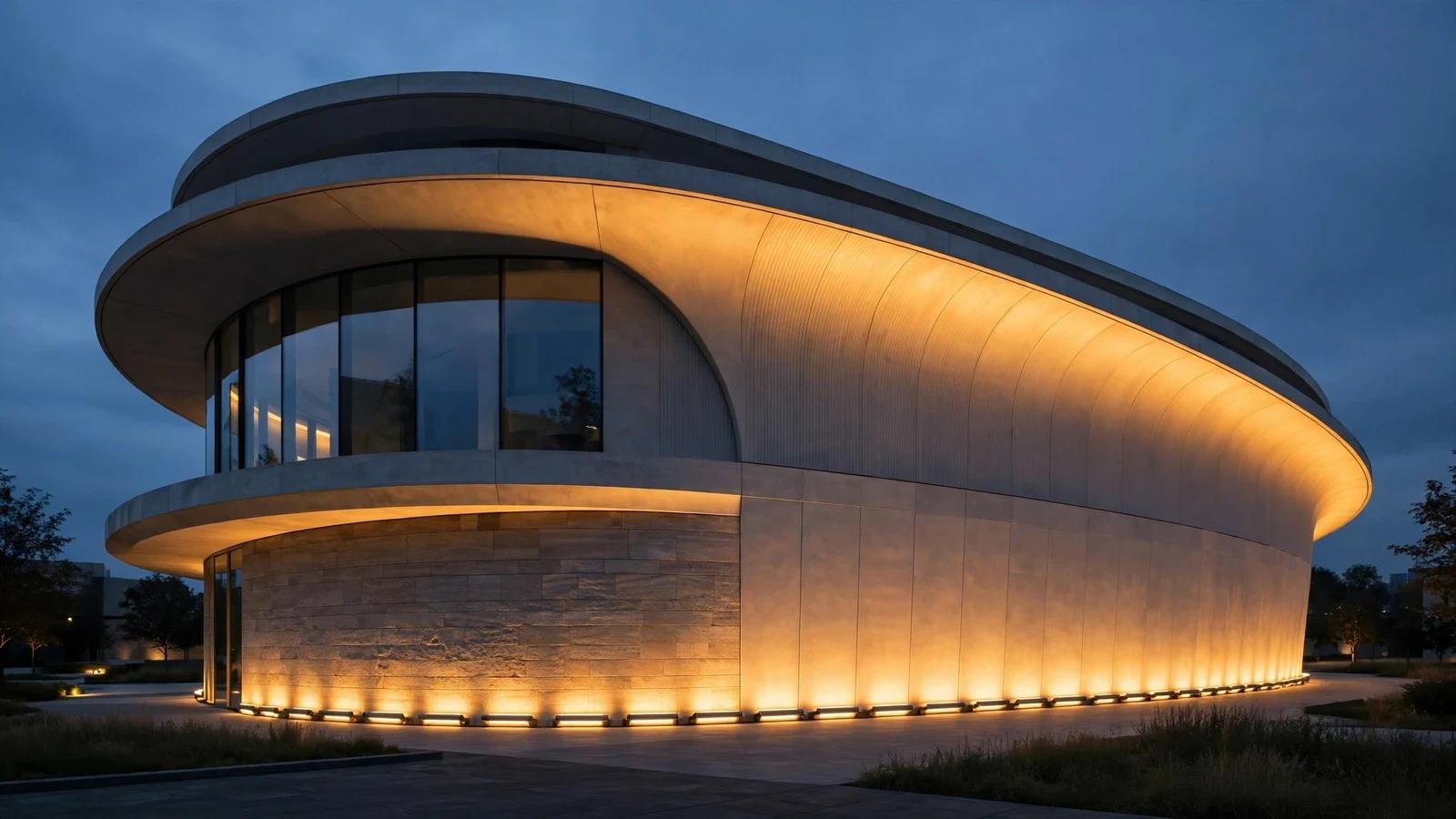
A curved facade is common on hotels, malls, museums, and office towers. The curve may be gentle or tight, and it may run in one direction only. A rigid washer cannot follow that shape, so it leaves dark gaps where the wall turns away from the light. A flexible washer bends with the wall, so each part of the facade gets light. The result is one smooth wash, not a row of bright spots.
Why a Rigid Washer Fails on a Curve
A rigid washer is a straight bar of light. It works well on a flat wall, because the distance from the light to the wall stays the same. On a curve, that distance changes along the wall, and the parts that turn away fall into shadow. The parts that turn toward the light get too bright, and the eye sees stripes, not a smooth wash.
The fix is not more power, because more power makes the bright spots brighter and the dark gaps darker. The fix is a fixture that follows the wall, and that is what a flexible washer is built to do. Each part of the fixture must sit at a steady distance from the surface. It bends in small steps, so the light stays even.
Before you compare products, measure the curve. Note the radius of the curve and the length of the run, and note where the curve starts and where it ends. Note any corners, joints, or changes in direction. These facts decide which flexible form fits, and they belong in your request to the supplier.
Two Flexible Forms: Chain Modules and Silicone Bodies
Flexible washers come in two main forms, and the first is a chain of small modules. Each module is a small light unit, and the units join like links in a chain. Each link bends a little, so the chain follows the curve in steps. The second form is a flexible silicone body, one continuous piece that bends as a whole and gives off light along its full length.
The difference matters for the look of the wash. A chain of modules gives a series of light patches, and if the patches overlap well, the wash looks even. If they do not, you see a row of spots, while a silicone body gives one continuous line of light. It suits curves where you want no visible breaks at all. Check the datasheet for how each form bends, and for the smallest radius it can take.
| Form | Bending method | Light continuity | Suitable curve |
|---|---|---|---|
| Chain modules | Small units join like a chain and bend step by step | A series of patches that must overlap well | A curve with a steady radius |
| Silicone flexible body | One continuous piece bends as a whole | One unbroken line of light | A changing curve or a design with no visible breaks |
Neither form is better in every case, and a chain suits a curve with a steady radius, where each module can sit flat. A silicone body suits a curve that changes, or a design that needs a clean line. Ask the supplier which form fits your radius. Ask for the bending limits in writing, and check them against your measured curve.
Match the Bend Direction to the Facade
A flexible washer can bend in more than one direction, and the three common types are top bend, side bend, and three-dimensional bend. Top bend curves up and down, like an arch. Side bend curves left and right, like a wave across a wall. Three-dimensional bend curves in both directions at once, for a surface that twists.
Match the bend type to your facade, since a curved wall that runs in a horizontal arc needs side bend. An arched opening or a curved canopy needs top bend, while a free-form surface that curves in two directions needs three-dimensional bend. A washer that bends the wrong way will fight the wall, and it may fail at the joints. Confirm the bend direction on the datasheet before you order.
| Bend direction | Facade geometry | What to check |
|---|---|---|
| Top bend | Arches and curved canopies | The arch radius against the bending limit |
| Side bend | Walls curving in a horizontal arc | The arc radius against the bending limit |
| Three-dimensional bend | Free-form surfaces curving two ways | Both radii and the joints between sections |
Beam Angle Decides Throw Height and Uniformity
The beam angle is the width of the light cone that leaves the fixture. A narrow beam throws light a long way, but it covers a small patch. A wide beam covers a large patch, but it does not reach as far. On a facade, the beam angle sets how tall the wash is, and how even it looks from the ground.
For a tall facade, a narrow beam reaches higher, but you may need more fixtures to fill the gaps. For a low facade, a wide beam gives a soft, even wash with fewer fixtures. The right choice depends on the wall height, the distance from the light, and the look you want. Do not pick a beam angle from a single number on a web page. Ask for the beam-angle datasheet, and check the throw and the spread it shows.
| Beam angle | Throw height | Patch size | Best use |
|---|---|---|---|
| Narrow | Long throw | Small patch | Tall facades that need height |
| Medium | Middle throw | Middle patch | Facades of average height |
| Wide | Short throw | Large patch | Low facades that need a soft, even wash |
Spacing matters as much as the beam angle, since fixtures set too far apart leave dark gaps. Fixtures set too close waste light and budget, so the supplier datasheet should state the spacing that gives an even wash for each beam angle. Ask for it, and check it against your facade height.
Control Protocol: What It Changes
Most flexible washers use a digital control protocol, such as DMX or SPI pixel control. The protocol decides how the lights are wired, and what scenes they can show. A simple setup may need only one colour and one brightness level. A scene with colour changes or chasing effects needs a protocol that can address each part of the run. A protocol that fits the scene list keeps the wiring simple, and it keeps the budget in check.
Choose the protocol after you choose the look, since a facade that needs only a steady wash takes a simple control setup. If it needs colour changes, scenes, or moving effects, plan the control system early. The wiring, the controller, and the power supply all depend on that choice, so confirm the protocol with the lighting designer before you order. Keep the control plan in the same document as the fixture choice, so the installer sees both at once.
Outdoor Protection Checklist
A facade washer lives outdoors, so weather protection is part of the selection. Rain, dust, heat, and cold all act on the fixture every day. Check the protection rating on the datasheet, and check how the fixture is sealed. A washer that is not sealed for outdoor use will fail early, and the failure often shows first as dim patches or dead sections.
- Check the ingress protection rating stated on the manufacturer datasheet, and confirm it fits an outdoor facade.
- Check how the fixture is sealed, including the encapsulation and the cable entries.
- Check the joints between sections, since a curve puts stress on every joint.
- Confirm whether the power supply and the controller are included, or supplied separately.
- Ask how the fixture is mounted, and whether one module can be replaced without removing the whole run.
For the profile side of an outdoor job, the choice of housing matters too. See how outdoor and wet-area LED profiles are selected for exposed locations. A good profile protects the light source, while the washer itself must still carry its own outdoor rating.
Before You Order: Questions to Ask
Use these questions with any supplier, and keep the answers in writing. Ask for the smallest bend radius the fixture can take, and compare it with your curve, then ask for the beam-angle datasheet. Check the throw it gives at your mounting distance, and ask which control protocol the fixture uses and what wiring it needs. Ask how the fixture is sealed for outdoor use, and what the warranty covers.
Note that NIUYUAN supplies aluminum profiles only. It does not supply wall washers, modules, or fixtures, so source the lights from a lighting supplier and the profiles from NIUYUAN. That split keeps the fixture warranty with the lighting supplier, and the profile order with NIUYUAN.
If your facade design also needs a curved aluminum profile, ask NIUYUAN about the bend radius and mounting of its bendable profile. Ask about it for your curve, and ask before ordering, since NIUYUAN bendable profiles are proven on curved ceilings. Whether they suit a curved facade wash is not yet verified, so confirm it with NIUYUAN first.
NIUYUAN runs 6 in-house extrusion lines in a 31,706 m² factory, and holds ISO 9001, RoHS, and CE certification. For profile orders, the minimum order is 1,000 pieces, tooling takes about 7 days, and lead time is 20–30 days from prepayment. Standard samples are free, with freight collect, and take about 7 days, while custom orders take 25–30 days and in-stock profiles ship in 3–7 days.
Frequently asked questions
What is a flexible LED wall washer?
It is a lighting fixture built to bend along a curve and wash a facade with light. Unlike a rigid washer, it follows the wall, so the light patches join into one even wash. NIUYUAN does not supply wall washers. It supplies aluminum profiles only, so source the fixtures from a lighting supplier.
Which flexible form suits a curved facade?
It depends on the curve. A chain of modules suits a curve with a steady radius, where each unit can sit flat. A silicone flexible body suits a changing curve, or a design that needs one unbroken line of light. Check the bending limits on the manufacturer datasheet against your measured curve.
How do I choose the beam angle?
Match the beam angle to the facade height and the mounting distance. A narrow beam reaches higher with a small patch, while a wide beam gives a soft wash over a large patch. Ask for the beam-angle datasheet, and check the throw and the spread it shows for your wall.
What control protocol do flexible washers use?
Most use a digital control protocol, such as DMX or SPI pixel control. The protocol affects the wiring and the scenes the facade can show. A steady wash needs only a simple setup, while colour changes and chasing effects need a protocol that can address each part of the run.
Can NIUYUAN supply the profile for a curved facade wash?
NIUYUAN supplies aluminum profiles only, and it does not supply wall washers. Its bendable profiles are proven on curved ceilings. Whether they suit a curved facade wash is not yet verified, so ask NIUYUAN about the bend radius and mounting for your curve, and ask before ordering. The minimum order is 1,000 pieces, and lead time is 20–30 days from prepayment.

Share this guide
Tell us what you need
Send Your Project Requirements
Share your contact details and tell us which LED profiles you need.
Explore custom profile options