
LED Profiles for Hotel Corridors
Hotel corridor LED profiles: zone-by-zone profile choices, night-mode dimming and buyer questions for hospitality projects. NIUYUAN guide.
On This Page
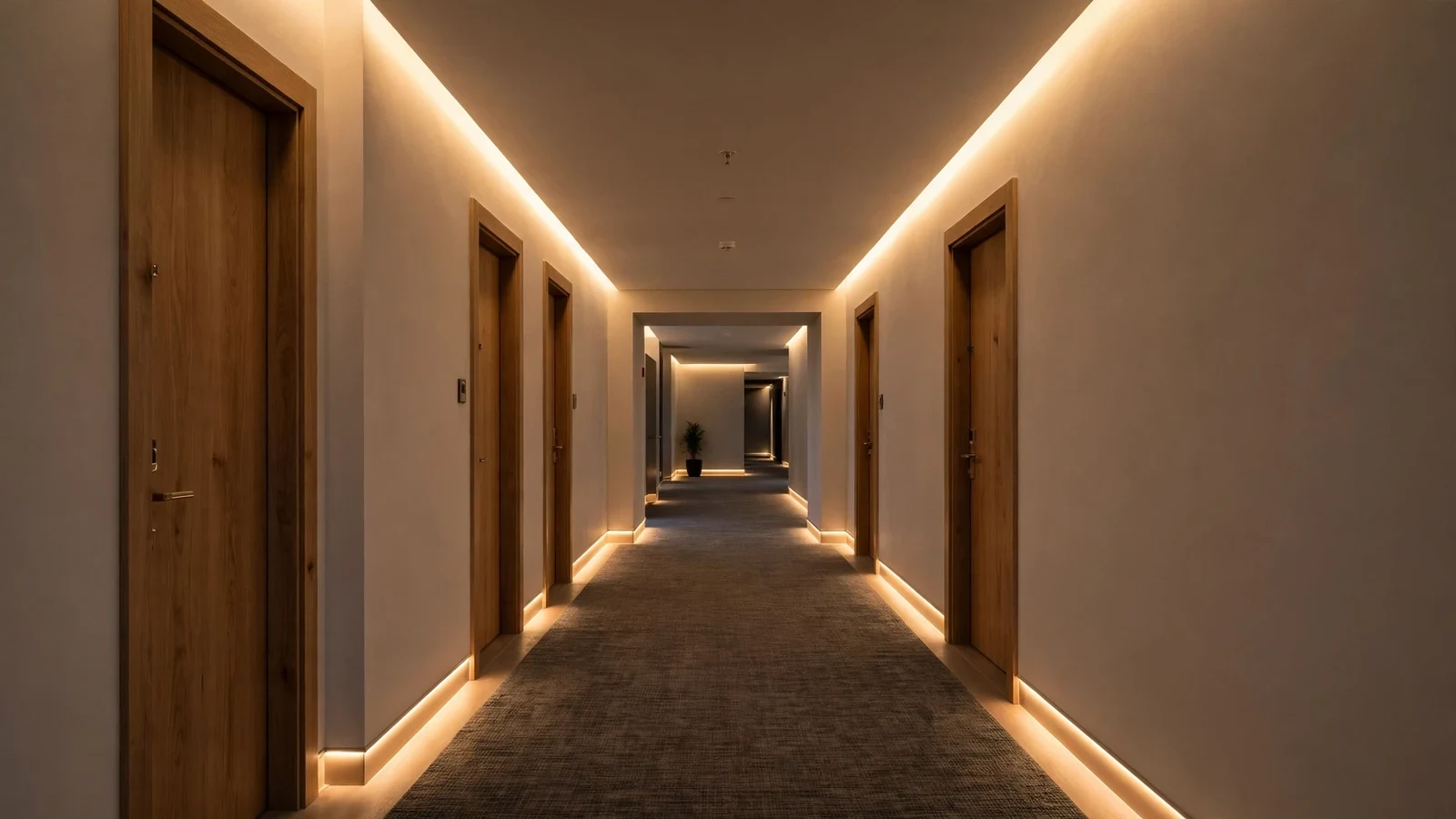
Hotel-corridor LED profiles are continuous aluminum channels installed along corridor ceilings, wall bases or walls. They give low-glare linear light that guides guests at night without disturbing guest rooms. A corridor is the first space a guest meets after the lift, and it shapes the first impression of the hotel. Good corridor lighting feels calm, even and warm, and it never calls attention to itself.
This guide covers the four corridor zones, the profile form for each zone, and night mode. It also lists the questions buyers should ask before they order profiles for a hotel project. Use it with our commercial profiles guide, which maps four commercial scenes in one place.
The sections below follow the guest walk, from the lift lobby to the room door. Each zone gets a profile form, a mounting note, and the requirement that matters most there. Night mode and buying questions close the guide, so the same page works for design and for ordering.
Why Corridors Need Continuous Linear Light
A hotel corridor is long, narrow and used at all hours, so point lights leave bright spots and dark gaps. A continuous line of light evens out the whole walk, from the lift lobby to the guest room door. Guests walk the corridor in the dark, often with luggage, so the floor line must stay clear at a glance. A profile channel spreads the light, hides the strip, and protects it from knocks and cleaning.
The channel also sets the light direction, so the beam washes a wall or a ceiling instead of shining into eyes. That indirect light is the main reason hotels choose cove and wall-base profiles over bare strips. Our cove lighting guide explains the general method for ceiling coves in more detail. This article stays with the corridor, and it applies that method zone by zone.
Corridors also serve staff and cleaners at night, so the light must work for work as well as for guests. A clear, even line helps staff spot a spill or a lost item without extra light.
Four Corridor Zones, Four Profile Choices
A corridor is not one space, and one profile form does not fit the whole walk. The ceiling, the wall base, the door recess and the lift lobby each ask for a different channel and a different mount. The table below sets out the four zones side by side, so a buyer can compare them at a glance.
| Zone | Profile form | Mounting | Key requirement |
|---|---|---|---|
| Ceiling cove | Recessed plaster-in or drywall channel | Set into the ceiling cove | Even wash with no visible source |
| Wall base guide | Low surface-mounted or recessed channel | Along the wall base | Low-glare line guests can follow |
| Door recess | Slim recessed channel | Set into the door frame recess | Clean edge with no light spill |
| Lift lobby | Surface-mounted or suspended channel | Ceiling or wall mount | Brighter welcome light at the entry |
The ceiling cove does most of the work, since it lights the whole corridor from above without a visible source. A plaster-in channel sits flush in a new ceiling, while a surface channel suits a corridor that is being refitted. The wall-base line is the night guide, and it runs low so it never shines into a guest room doorway. Door recesses and lift lobbies finish the walk, and they need the same colour temperature as the rest.
Night Mode: Dimming Without Dark Spots
Corridors run all night, but the light level late at night should not match the level at check-in time. Night mode dims the corridor to a low, even glow, and it lifts the light when a guest walks through. Sensors sit along the corridor, so the light rises before the guest reaches the dark stretch ahead. The change should feel smooth, not a sudden switch, so guests never notice the light working.
Keep one colour temperature through the whole night, since a shift in colour reads as a fault to guests. Check the dimming level and the sensor timing against the local code and the hotel brand standard. No single dimming figure suits every hotel, so treat any percentage in a supplier guide as a starting point only. Ask the driver supplier how the sensor and the driver work together, since NIUYUAN supplies profiles only.
Test night mode on one corridor first, and walk it at night before the hotel signs off the whole floor. A short trial run shows dark spots, sensor gaps and glare that a daytime check would miss.
Colour Temperature and Colour Rendering
Hotels often choose 2700K warm white for corridors, since warm light feels calm after dark. Public areas may run a little cooler, but the corridor itself should stay warm and steady. Our colour temperature guide explains how 2700K compares with cooler options for commercial spaces. Keep the same colour temperature in every zone, or the corridor will look patched together.
Hotels also often choose high colour rendering, with CRI 90 or above as the common baseline in hotel guides. High rendering keeps wood, carpet and skin tones true, which matters when guests judge a hotel by its corridor. Our CRI guide explains what the CRI number means and how to read it before ordering. These are hotel-guide tendencies, not NIUYUAN product specifications, so confirm them with the project team.
Ask for a sample before a large order, and check the colour against the corridor finishes under real light. A sample also shows the diffuser finish, which sets how soft the line looks on the wall.
Joints, Runs and Finishes: What to Check Before Ordering
A hotel corridor runs long, so the profile must run in straight lengths with clean, even joints. Ask the supplier for the longest continuous run, the joint method, and the connector parts that hide the seam. Corners need the right angle channel, so check whether the corridor has wall-to-wall or wall-to-ceiling turns. Luggage and cleaning trolleys hit the wall base every day, so the finish there must resist scuffs.
NIUYUAN profiles use 6063-T5 aluminum alloy, and the factory runs six in-house extrusion lines. Custom profiles take 25–30 days, while in-stock profiles ship in 3–7 days. New tooling takes about 7 days, and the minimum order is 1,000 pieces across the range. Standard samples are free, with freight collect, and they arrive in about 7 days.
Match the diffuser to the zone, since a frosted cover softens the line while a clear cover shows each diode. Check the end caps and the mounting clips in the sample, since small parts decide the finished look.
What to Ask Before You Buy
Use this checklist in the first supplier call, so the quote covers the full corridor and not just the channel. It also stops the common gap where profiles arrive on time but connectors, drivers or samples lag behind.
- What is the longest continuous run, and which connectors hide the joints?
- Which profile form fits each zone: ceiling cove, wall base, door recess or lift lobby?
- How do the sensor and the driver work together for night mode?
- What colour temperature and CRI can the strip paired with the profile reach?
- Can we see a sample against our corridor finishes before ordering?
- What is the lead time from prepayment, and what ships from stock?
- What does the 1,000-piece minimum order cover per profile length?
NIUYUAN runs a 31,706 m² factory, holds ISO 9001, RoHS and CE certification, and exports to North America, Europe, the Middle East and Oceania. Across all projects, NIUYUAN has completed more than 36,000 projects worldwide. Lead time runs 20–30 days from prepayment, so plan the corridor order with the fit-out schedule.
Frequently asked questions
Which LED profile form suits a hotel corridor ceiling?
A recessed plaster-in channel suits a new ceiling, since it sits flush and hides the light source. A surface-mounted channel suits a refit, since it mounts without cutting the ceiling. Check the diffuser with the ceiling finish, since a soft cover suits a low corridor ceiling.
What colour temperature do hotels often choose for corridors?
Hotels often choose 2700K warm white for corridors, since warm light feels calm after dark. Keep the same colour temperature in every zone, and check the project standard before ordering. Public areas may run a little cooler, but keep the corridor warm and steady.
How does night mode work in a hotel corridor?
Night mode dims the corridor to a low, even glow and lifts the light when a guest walks through. Check the dimming level and sensor timing against the local code and the hotel brand standard.
What is the minimum order for NIUYUAN LED profiles?
The minimum order is 1,000 pieces, the same across the LED profile range. Lead time runs 20–30 days from prepayment, and standard samples are free with freight collect. New tooling takes about 7 days, and custom profiles take 25–30 days in total.
Does NIUYUAN supply drivers for hotel corridor lighting?
No, NIUYUAN supplies aluminum profiles only, and drivers come from a separate supplier. Ask the driver supplier how the sensor and driver work together for night mode. NIUYUAN supplies the aluminum profile, and the driver supplier covers the sensor pairing.

Share this guide
Tell us what you need
Send Your Project Requirements
Share your contact details and tell us which LED profiles you need.
Explore custom profile options