
Specify LED Profiles for a Distributor Range
How to specify LED profiles for a distributor range: four installation types, a per-model checklist, and a stock-versus-custom split for MOQ and lead time.
On This Page
A distributor range is a set of LED profile models that do not overlap and cover the main installation scenarios in one catalogue. It is not a list of every product a factory can make, but a list that a distributor can stock, explain and sell without confusion.
A good range answers three questions for every buyer. Which profile fits this installation, and what length, finish and diffuser does it need? How fast can it ship, and what is the minimum order? If a model cannot answer all three, it does not belong in the catalogue.
Start with the Four Installation Types
Most distributor catalogues fail in the same way, listing too many similar sections and leaving gaps in the scenarios buyers actually ask for. A range works better when it starts from installation types, not from a factory product list. Four types cover nearly every job a distributor will see, and surface mount, recessed, corner and suspended profiles each solve a different mounting problem. If a catalogue covers all four, it can serve most rooms and most projects.
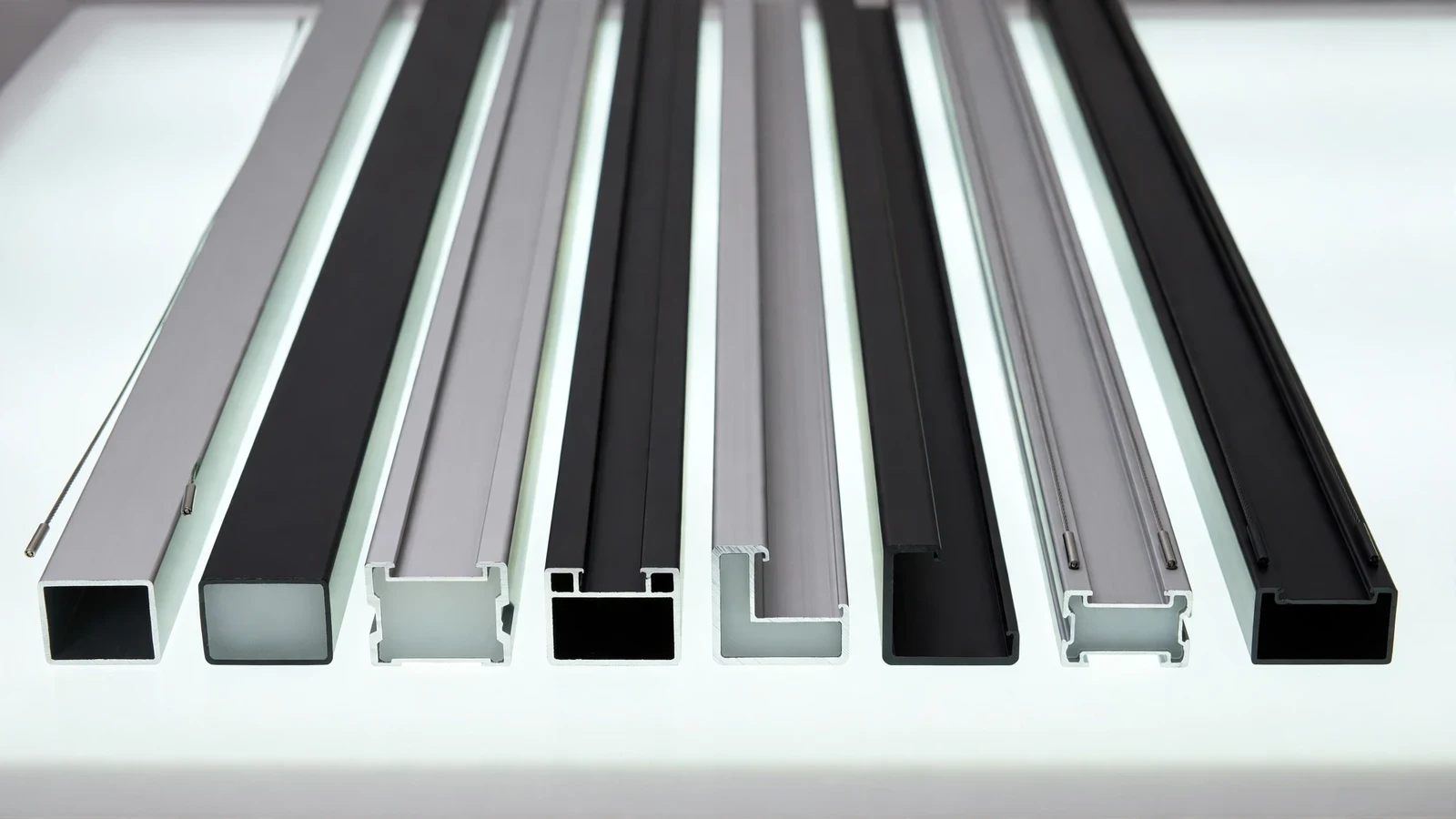
Surface mount profiles fix to a visible surface with clips or screws, and they suit rooms where the ceiling or wall cannot be cut. Recessed profiles sit flush in a groove in the ceiling or wall, and they suit clean interiors where the light source should disappear. Corner profiles fit into a 90 degree angle, often under cabinets or along a ceiling edge. Suspended profiles hang from cables and suit high ceilings, and each type needs its own section shape.
For one project rather than a whole range, our guide to choosing an LED aluminum channel covers the single-project decision.
Match Each Type to Indoor and Outdoor Jobs
The same installation type can serve an indoor job and an outdoor job, but the specification changes. An indoor surface mount profile in a dry office needs a standard diffuser and a common finish. The same profile on a covered terrace needs a sealed diffuser and a finish that resists moisture. The table below shows one starting point for each quadrant, and you can use it to check for gaps, not as a final order list.
| Installation type | Indoor jobs | Outdoor jobs |
|---|---|---|
| Surface mount | Offices, retail shelves and corridors; standard diffuser, common finish | Covered terraces and soffits; sealed diffuser, moisture resistant finish |
| Recessed | Ceilings, wall coves and kitchen pelmets; flush fit, clean look | Sheltered eaves and entrance canopies; sealed ends, drainage considered |
| Corner | Under cabinets and ceiling edges; 45 degree beam, glare control | Pergola beams and garden walls; sealed diffuser, weather resistant finish |
| Suspended | Open plan offices and showrooms; cable hang, even light over desks | Covered walkways and carports; sealed profile, corrosion resistant finish |
Check the table against your sales history, and if most orders sit in one quadrant, add depth there before you add a new quadrant. A distributor that sells mainly indoor recessed profiles needs more lengths and finishes there, not a suspended range it rarely sells. Outdoor quadrants need extra care with sealing. Before you list an outdoor model, check its IP rating against the installation environment. Our IP ratings guide for LED profiles explains the common ratings in plain terms.
Check Every Model Against the Same Specification List
Every model in the range needs the same seven data points on file. If one point is missing, the model is not ready to list. Buyers will ask for it, and the warehouse will need it to pick and pack the order. The list below works for stock models and custom models alike, so keep one sheet per model. Update it when a finish or diffuser changes.
- Section: cross-section size and shape, matched to the installation type and the strip it will carry.
- Length: standard stock lengths and the longest cut length the factory can supply.
- Finish: anodized or powder-coated surface, with the color code on file.
- Diffuser: opal, clear or frosted cover, with the beam effect it gives.
- Accessories: end caps, clips, brackets and connectors that fit this section.
- MOQ: minimum order quantity, which is 1,000 pieces per model at NIUYUAN.
- Lead time: 3–7 days for stock models, and 25–30 days for custom orders from prepayment.
Finish and Accessories Deserve a Closer Look
Finish deserves a closer look, because it changes both the look and the price of a model. Anodized finishes resist scratches and suit commercial jobs, while powder-coated finishes offer more colors and suit retail and residential jobs. Compare the two before you fix the finish for a model, and record the choice on the specification sheet. Our comparison of anodized and powder-coated LED profiles sets out the trade-offs in detail.
Accessories cause more order errors than any other item on the list. A clip that fits one section often does not fit another, even when the two sections look alike. End caps and connectors are section-specific too. List the exact accessory codes beside each model, and never assume that an accessory from one model fits another. If a buyer orders a profile without its clips, the job stops on site.
Split the Range into Stock Models and Custom Models
A distributor range needs two halves, and they play different roles. Stock models are the fast sellers a distributor keeps on the shelf. Custom models are the special sections a distributor orders only when a project needs them. Stock models run out when custom orders take their shelf space, and custom models sit unsold when stocked like fast sellers. Keep the split visible in the catalogue, so buyers know what ships at once and what needs a production run.
Stock models should be the smallest set that covers the most common jobs. Pick one section for each of the four types to start. Add a second section in a type only when sales data shows a real gap. Each stock model needs a standard length, one or two finishes, and one diffuser, which keeps the shelf simple and the picking fast. NIUYUAN ships stock models in 3–7 days, so a distributor can reorder often and hold less stock.
Custom models earn their place when no stock model can provide the section, such as a new cross-section, a special finish or an unusual length. New tooling takes about 7 days, and custom orders take 25–30 days. Ask for a standard sample before the first bulk order, and allow about 7 days for it to arrive; samples are free, with freight collect. For custom work, request the catalogue from NIUYUAN before you list the model.
Read the Spec Sheet Before You List a Model
A spec sheet often covers a whole product series, not one single model. The highest light output, the lowest power use and the control options may belong to different configurations. Never list a model from the series name alone, and check the full catalogue number and the option matrix for the exact configuration. Then check voltage, control, installation method and environment rating for that same configuration. If any of these do not match, the model is not ready to list.
Certifications belong on the same check, so confirm that the model carries the marks your market needs before you print the catalogue. NIUYUAN profiles carry ISO 9001, RoHS and CE marks, and the profiles use 6063-T5 aluminum alloy. Record the alloy and the marks on the specification sheet, so a buyer can check them without asking. A distributor that can answer a certification question at once wins trust faster than one that has to ask the factory first.
Profiles are only one part of the finished light, and NIUYUAN supplies aluminum profiles only, while drivers and power supplies come from a separate supplier. Check that the profile, the strip and the driver work together before you list a model. A profile that cannot take the strip a buyer plans to use will come back as a complaint, not a repeat order.
Keep the Catalogue Lean
The biggest cost in a distributor range is not the shelf space, but the minimum order on every model. NIUYUAN sets the minimum order at 1,000 pieces per model, and the figure does not vary by model. In practice, this means that each extra custom model in the catalogue adds another 1,000-piece minimum order to the buying plan.
A range with twenty custom sections needs twenty minimum orders, while a range with six sections needs six. That is the author analysis behind the lean catalogue rule, and it follows from the confirmed minimum order, not from a catalogue policy quotation.
A lean catalogue uses few sections and many variants. One section can serve several jobs when the length, finish and diffuser change. A short length suits a kitchen run, and a long length suits a corridor. That is how a distributor covers more scenarios with fewer minimum orders. Start with six to eight models, and add one only when a real order asks for it. A model with no orders in a year should leave the catalogue.
Confirm Commercial Terms with NIUYUAN
Selection and specification are only half of a distributor agreement. Discounts, payment terms, exclusive territories and return policies all need a direct answer from NIUYUAN before a distributor signs. This article does not state them, because they are not confirmed. Ask NIUYUAN to confirm each term in writing, and record the answer beside the range plan. A distributor that knows its terms can quote a buyer at once, while one that guesses will have to check every order.
The factory behind the range matters too. NIUYUAN runs 6 in-house extrusion lines in a 31,706 m² factory, and it has completed 36,000+ projects around the world. Its export markets include North America, Europe, the Middle East and Oceania, and lead time runs 20–30 days from prepayment for most orders. Ask about current capacity before you commit a large range, and plan the first order around the lead time, not around the launch date.
Frequently asked questions
What is a distributor range for LED profiles?
A distributor range is a short list of profile models that cover the main installation types without overlap. It starts with one model for each: surface mount, recessed, corner and suspended, while length, finish and diffuser create the variants. The goal is a catalogue buyers can read in minutes, not a list of every section the factory can make.
How many models should a distributor range start with?
Six to eight models are enough. One section for each of the four installation types covers most jobs, with a second section only where sales data shows a gap. Each extra model adds work and stock, so add models one at a time and drop a model with no orders in a year.
What is the minimum order for each LED profile model?
NIUYUAN sets the minimum order at 1,000 pieces per model, and it does not vary by model. In practice, each extra custom model adds another 1,000-piece minimum order to the buying plan. Keep the range lean and use length, finish and diffuser as variants instead of new sections.
How long does a custom LED profile order take?
New tooling takes about 7 days. Custom orders take 25–30 days from prepayment, while stock models ship in 3–7 days. Ask for a standard sample before the first bulk order and allow about 7 days for it to arrive; samples are free, with freight collect.
Does NIUYUAN supply drivers and power supplies with its profiles?
No, NIUYUAN supplies aluminum profiles only, and drivers and power supplies come from a separate supplier. Check the profile, strip and driver work together before you list a model. Your driver supplier can confirm voltage and control compatibility for the strip you use.

Share this guide
Tell us what you need
Send Your Project Requirements
Share your contact details and tell us which LED profiles you need.
Explore custom profile options