
Ambient Lighting: The Comprehensive Guide
Ambient lighting explained: what it is, how the three lighting layers work, and where LED aluminum profiles create soft, even light.
On This Page
Ambient light is the uniform base lighting that fills a whole room. It lets people move around safely without glare, and the source itself is often hidden from view. Light may first hit the ceiling or a wall, and it then reflects back into the room. The result is soft light that feels even. This guide explains ambient light, shows how it works with task light and accent light, and shows where LED aluminum profiles create it.
Many rooms fail on ambient light before any lamp is chosen, because a single ceiling bulb leaves dark corners and throws hard shadows on faces. A row of bare downlights can feel harsh too. The fix is rarely more power, since better placement and better diffusion solve the problem.
LED strips inside aluminum profiles solve both problems at once. The profile hides the strip from view, and the diffuser softens the output. The light then spreads evenly across a surface, so the room feels calm and bright at once. This article stays at the hub level, covers the idea, the layers, and the positions, and leaves room detail in linked guides.
What Ambient Light Does in a Room
Ambient light sets the base level of a room. It answers one question: can a person see the room and move through it with ease? Good ambient light has no bright spots, no dark corners, and no visible glare source. The eye moves across the room without strain, so if a guest squints at a bare lamp, the ambient layer has failed.
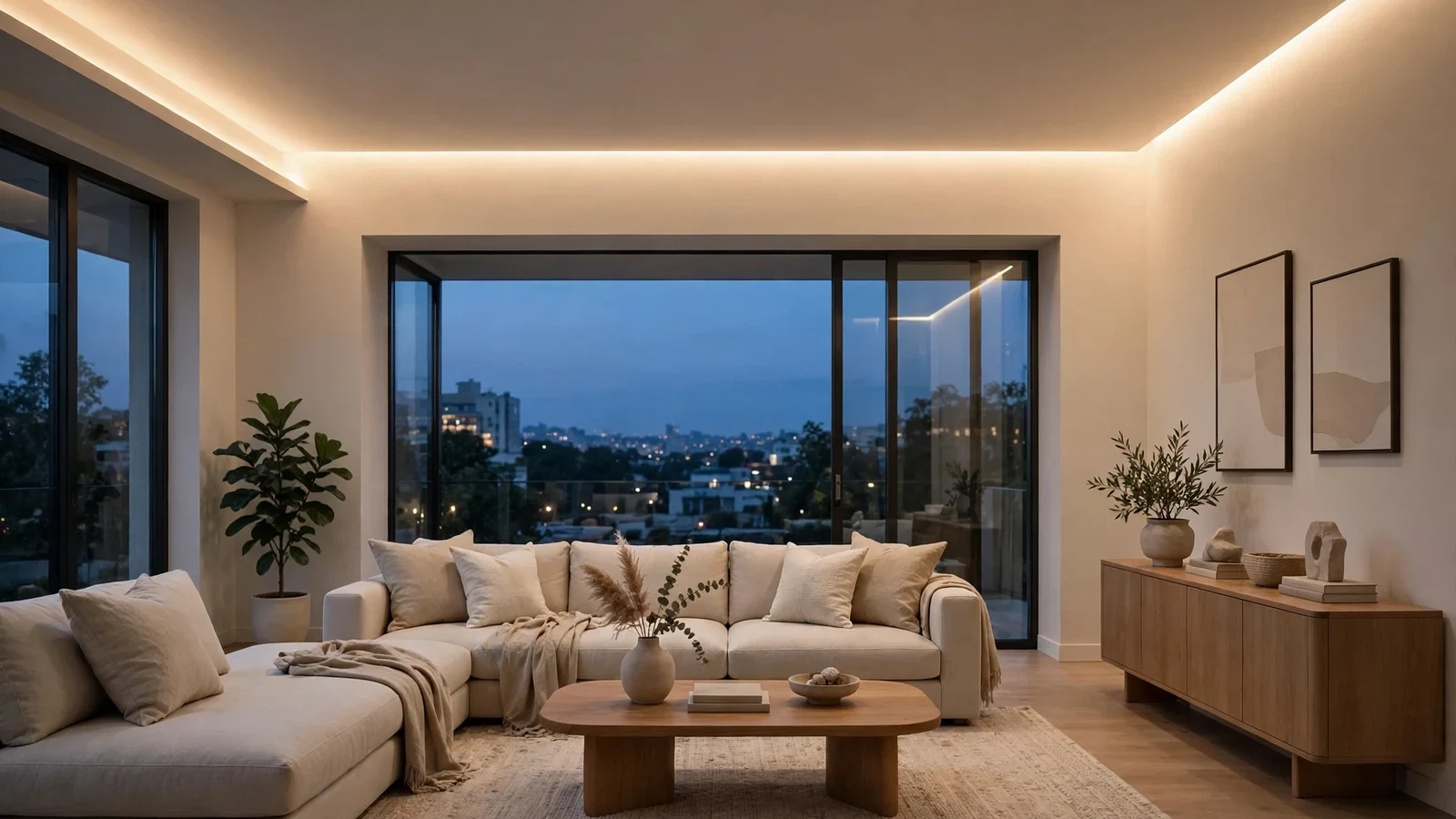
Indirect light is the most elegant way to build this layer. A strip sits inside a profile in a cove, and the light hits the ceiling first. The ceiling then spreads it back down, so the whole ceiling seems to glow. No lamp is visible from below, and the same idea works behind furniture and along a cornice. The surface becomes the light source, and the room feels calm and even.
Ambient light also sets the mood of a room. A warm tone feels relaxed in the evening, while a neutral tone suits work and daytime use. The choice depends on the room and its use, while wall color and daylight shift the final feel. Test the light in the real room. Brightness is a separate decision from mood, so check the strip specification for the room use and do not judge brightness by color temperature alone.
The Three Lighting Layers
Most good rooms use three layers of light, and each layer has one job. Ambient light is the base, task light serves a job, and accent light draws the eye. The layers work together, since no single layer can do all three jobs, and the table below sets out the split.
| Layer | Job | Typical use | Profile approach |
|---|---|---|---|
| Ambient | Base light for the whole room | General movement and orientation | Cove, cornice, skirting, behind furniture |
| Task | Focused light for a job | Reading, cooking, desk work | Under cabinet, shelf, desk edge |
| Accent | Light that draws the eye | Art, displays, wall features | Recessed wall wash, shelf edge, niche |
Ambient light comes first in every plan, so set the base level before adding task light. A room with task light alone feels dark outside the beam, with black corners and a dark ceiling. Add ambient light first, then place task light where hands work. The two layers should not fight, so keep one color temperature in each room and let the layers feel like one scheme.
Accent light comes last, because it needs a dark enough background to stand out. A room flooded with ambient light leaves no contrast, so keep accent light focused and dimmer than the base. Use it on one feature at a time, such as a shelf, a painting, or a textured wall. Too many accents compete with each other, and the eye then finds no resting point, so restraint is what makes accent light work.
Where LED Aluminum Profiles Create Ambient Light
An aluminum profile turns a bare strip into finished ambient light. It holds the strip straight, hides the dots, and carries heat away from the strip. It gives the diffuser a fixed seat, while four positions do most of the work and each one suits a different room shape. The table below compares them.
| Position | How it is installed | What it does | Key requirement |
|---|---|---|---|
| Cove | Profile sits in a ceiling cove, light aimed up | Ceiling glows, light falls soft and even | Enough cove depth for the beam to spread |
| Cornice | Profile runs along the wall top edge | Wall top glows, room edge feels taller | Straight run with no visible joints |
| Behind furniture | Profile fixed behind a headboard or shelf | Soft halo behind the object | Hidden fixing with no light leak at the ends |
| Skirting | Profile set into or above the skirting line | Low glow that guides movement at night | Diffuser flush with the wall surface |
Cove lighting is the classic ambient position, and it suits living rooms, hotels, and meeting rooms. The ceiling becomes a large soft source. Our guide to cove LED profiles covers profile choice and install detail for this position, so this article does not repeat that detail. Read it when the cove is your main plan.
Cornice and skirting positions suit rooms with low ceilings. A cove needs depth above the ceiling line, while a cornice needs only the wall top edge. Skirting light sits low and guides the eye in hallways and bedrooms. Behind furniture light suits headboards and shelving, and it adds a halo without a visible lamp. Each position changes the feel of the same room. Choose the position for the room shape first, and then the profile that fits that position.
How to Choose Profiles for Ambient Light
Start with the diffuser, because it decides whether the eye sees dots or a smooth line. An opal diffuser spreads light the most, while a frosted diffuser keeps more output with a soft look. A clear cover shows the strip and suits task light only, so choose opal or frosted for ambient light. Our guide to choosing LED aluminum channels explains the full selection logic, from profile shape to diffuser choice.
Next, check the profile depth, since a deep profile hides the strip better. It gives the diffuser room to blend the light, but a shallow profile can show dots with dense strips. Ask for the profile cross section before you order and check the strip width against the channel width. A strip that fits loose will shift over time. A strip that fits tight is hard to replace. Fit is a small detail with a large effect on the finish.
Plan continuous runs before you buy, since long runs need joints that stay invisible. Ask how sections join and how corners are handled. A visible joint breaks the line of light and draws the eye to the wrong place. Corners need matching connectors or mitred cuts. Check the plan on paper first, mark each run, each joint, and each corner, and a short sketch saves a failed install.
Color Temperature and Color Rendering for Ambient Light
Ambient light sets the tone of a room, so color choice matters. Warm white feels relaxed in living rooms and bedrooms, while neutral white suits kitchens and work areas. Cool white suits workshops and inspection areas, so keep one color temperature inside each room. Mixing warm and cool light in one room looks uneven at once. Our guide to LED color temperatures explains each band and the rooms it suits.
Color rendering is a separate choice from color temperature. It measures how true colors look under the light, and food, wood, fabric, and skin all show the difference. A high rendering index keeps those colors natural, while a low index makes them look flat or grey. Our CRI guide explains the index and the levels that fit each use, so state both color temperature and CRI in your brief.
Buying Questions Checklist
Use this checklist when you ask a supplier for a quote. It covers the points that decide whether ambient light looks smooth or patched, so send it with your room sizes and a short sketch. A supplier who answers each point clearly is easier to work with.
- Ask for the longest continuous run the strip and profile can support in one feed.
- Ask which diffuser gives a dot-free line with your chosen strip density.
- Ask how sections join and how corners are handled in a long run.
- Ask which dimming method the strip supports and whether it dims smoothly to low levels.
- Ask for a sample in the profile and diffuser you plan to use.
- Ask for the strip specification, including color temperature and CRI, in writing.
- Ask about lead time, tooling time, and the minimum order quantity before you commit.
- Ask how the profile is fixed and what accessories the install needs.
Working with NIUYUAN on an Ambient Lighting Project
NIUYUAN makes aluminum profiles for ambient light in cove, cornice, furniture, and skirting positions. The profiles use 6063-T5 aluminum alloy, and the factory covers 31,706 square meters with six in-house extrusion lines. The company holds ISO 9001, RoHS, and CE certification, and it exports to North America, Europe, the Middle East, and Oceania. It has completed more than 36,000 projects around the world.
The minimum order quantity is 1,000 pieces. Standard samples are free, with freight collect, and they arrive in about 7 days. New tooling takes about 7 days, while lead time is 20–30 days from prepayment. Custom orders take 25–30 days, and in-stock profiles ship in 3–7 days. NIUYUAN supplies profiles only, so drivers and power supplies come from the buyer side and need planning as a separate item.
Frequently asked questions
What is ambient lighting?
Ambient light is the uniform base lighting that fills a whole room. It lets people move around safely without glare, since the source is often hidden or the light reflects off the ceiling or a wall first. It is the base layer of light in a room, with task light and accent light sitting on top of it.
How is ambient light different from task light and accent light?
Ambient light covers the whole room. Task light serves one job, such as reading or cooking, while accent light draws the eye to one feature, such as art or a display. A good room uses all three layers, with ambient light first and task and accent light following.
Can LED strips create good ambient light?
Yes, when the strip sits inside an aluminum profile with a diffuser. The profile hides the strip and carries heat away, while the diffuser blends the dots into a smooth line. Place the profile in a cove, along a cornice, behind furniture, or at skirting level. The light then reflects off a surface and fills the room evenly.
What color temperature should ambient light use?
It depends on the room and its use. Warm white suits living rooms and bedrooms, while neutral white suits kitchens and work areas. Keep one color temperature inside each room, since our guide to LED color temperatures covers each band in detail.
What should I ask a supplier before ordering profiles for ambient light?
Ask for the longest continuous run, the diffuser that gives a dot-free line, and the dimming method. Ask for a sample in the profile you plan to use, and confirm the minimum order quantity, lead time, and tooling time in writing. NIUYUAN works to a 1,000 piece minimum order, with lead time of 20–30 days from prepayment.

Share this guide
Tell us what you need
Send Your Project Requirements
Share your contact details and tell us which LED profiles you need.
Explore custom profile options