
Diffuser Light Loss: How Much Brightness Is Lost?
A diffuser can cut 5–70% of the light from an LED strip. Learn how much each cover type loses, where the light goes, and how to make it up.
On This Page
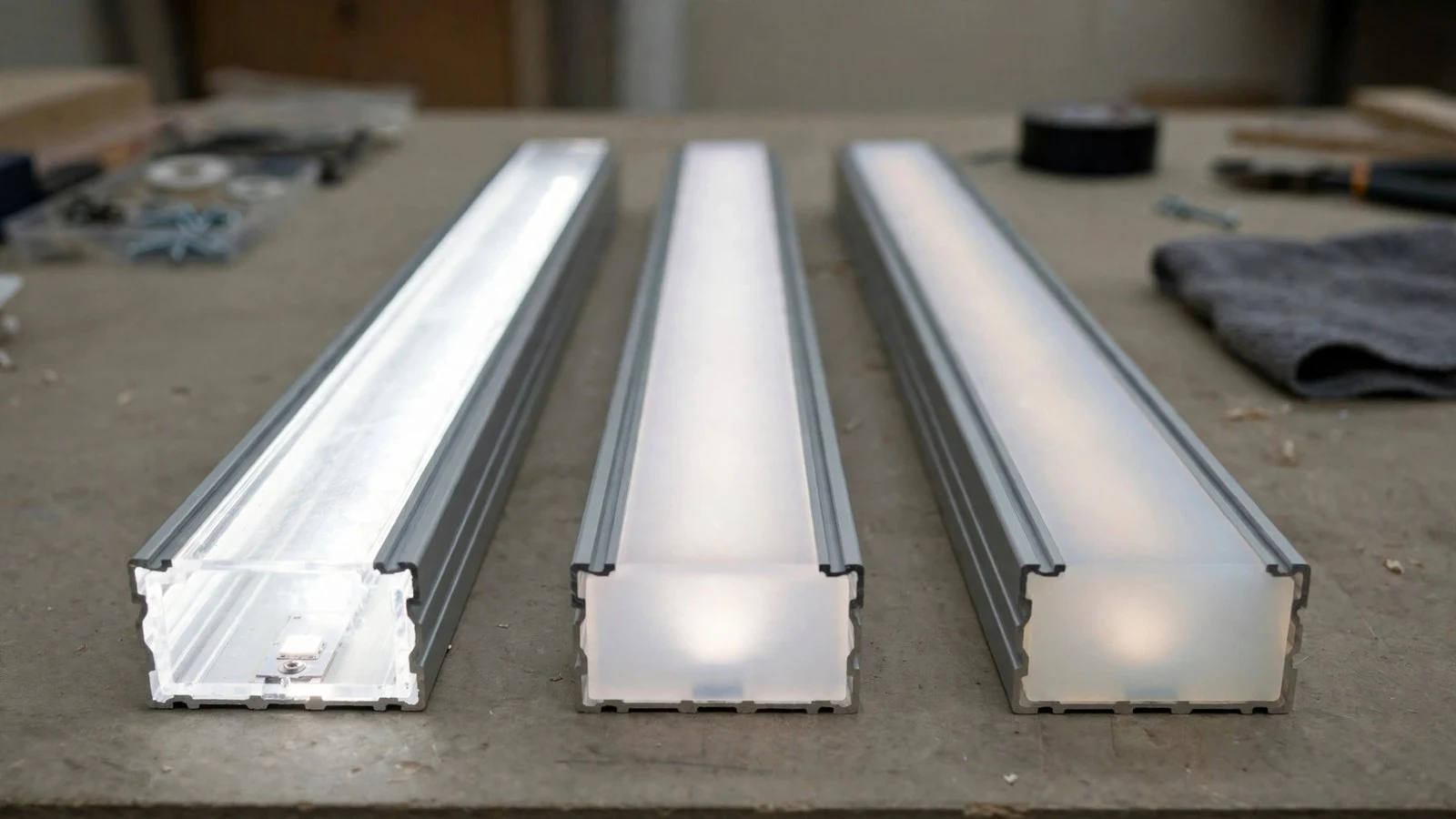
A diffuser always costs some brightness. A clear cover passes about 90–95% of the light from the LED strip, so it loses only 5–10%. A frosted cover passes about 75–90%, and an opal cover passes about 58–85%. A black cover passes only about 30–40%, so it loses most of the light. These are ranges from supplier data, not fixed values for one product.
This article answers one question only. It asks how much brightness you lose with each diffuser, where that light goes, and how to make it up. It does not repeat the buying advice in our other diffuser guides. Our opal vs frosted vs clear guide compares the three cover types and helps you pick one. Our PC vs PMMA guide compares the two diffuser materials.
Our dotless lighting guide shows how to hide the bright dots along the strip. Read this article for the numbers, then use those guides to pick the cover. The rest of this article works through the loss figures first, then the reasons behind them, then the ways to make the brightness back.
How much light does each diffuser lose?
Transmittance is the share of light that passes through the cover. A cover with 90% transmittance lets 90% of the light through and loses 10%. A cover with 70% transmittance loses 30%. The table below shows the usual ranges for the four common cover types. Treat each range as a starting point, not as a promise for one product.
| Cover type | Transmittance | Light lost | Best for |
|---|---|---|---|
| Clear | About 90–95% | About 5–10% | Maximum brightness, dots visible |
| Frosted | About 75–90% | About 10–25% | Softer light with a mild glow |
| Opal (milky) | About 58–85% | About 15–42% | Even glow with dots hidden |
| Black | About 30–40% | About 60–70% | Dark look, strong dimming effect |
Read the loss column as the price of diffusion. A clear cover keeps almost all the light, but it shows every bright dot on the strip. An opal cover hides the dots, but it can cut the light by a third or more. A frosted cover sits between the two, with a mild glow and a smaller loss. A black cover is a design choice, not a brightness choice, because it throws away most of the light.
Where does the lost light go?
The lost light does not vanish. Part of it is absorbed by the cover material and turns into a small amount of heat. The rest is scattered back into the channel, where it bounces between the cover and the strip. Some of that bounced light escapes on a second pass, while some is absorbed by the channel walls. A darker cover absorbs more, so it loses more light than a clear one.
This is why brightness and evenness pull in opposite directions. A cover that scatters light well spreads it across the surface, and that spread is what hides the dots. The same scattering sends more light back into the channel, so less light reaches the room. You cannot have the softest glow and the highest brightness from the same cover. Pick the balance that fits the scene, then make up the loss with a brighter strip.
Why do the numbers differ from one supplier to another?
You will find different transmittance figures for the same cover type, and that is normal. One supplier may test a thin clear sheet, while another tests a thick opal sheet in a deep channel. The number also shifts with the material, the recipe and the test setup. So compare figures only when they come from the same test, and always ask for the datasheet behind a number.
Four variables move the number most, so check each one before you compare two covers side by side. A single figure without these details tells you little about the cover you will actually receive. Ask the supplier for the test conditions behind the figure, and keep the comparison on the same model.
- Material: PC, PMMA and silicone scatter light in different ways, so the same cover type can read differently in each material.
- Thickness: a thicker cover blocks more light than a thin cover of the same type.
- Recipe: the mix of diffuser particles sets how much light is scattered, and recipes differ by maker.
- Channel model: the depth and the inner finish of the channel change how much bounced light escapes.
How the channel shape changes the loss
The cover is not the only thing that costs light. A deeper channel gives the bounced light a longer path, so more of it is absorbed before it can escape. A thicker cover adds the same kind of loss, because the light must pass through more material. A dark inner finish absorbs bounced light, while a light finish reflects more of it back out. The rule is simple: a deeper channel and a thicker cover mean more loss.
No single test figure covers every channel shape, so do not trust a loss percentage that claims to fit all models. One maker may test a shallow channel, while another tests a deep one, and the two results will not match. Ask for the figure measured on the same channel model you plan to order. If the supplier cannot give one, ask for a sample and test it with your own strip.
How to make up the lost brightness
Once you know the loss, you can plan around it. The usual fix is a brighter strip, but that is not the only option. A clearer cover, a shallower channel or a lighter inner finish can each win back some light. Work through the list below before you order, and check the result with a sample.
- Pick a brighter strip: a strip with about 40% more lumens makes up for a cover that loses about 30%.
- Switch to a clearer cover: a frosted cover loses less than an opal cover, so it keeps more light for the same strip.
- Use a shallower channel: a shallow channel lets more bounced light escape than a deep one.
- Check the datasheet first: ask for the transmittance figure measured on the same channel model, not a generic figure.
- Test a sample: fit the strip and the cover, then measure the light at the work surface before you order in bulk.
How this article differs from our other diffuser guides
We already publish three guides on diffusers, and each one does a different job. Our opal vs frosted vs clear guide compares the three cover types and helps you pick one for your scene. Our PC vs PMMA guide compares the two diffuser materials, so you can choose between them. Our dotless lighting guide shows the full set of steps that hide the bright dots along the strip.
This article does a different job. It answers the numbers question: how much light each cover loses, where that light goes, and how to make the loss back. Read this article for the loss figures, then use the three guides above to pick the cover type, the material and the dotless setup.
Questions to ask before you order
Ask these questions before you place an order, because the cover choice is hard to change once production starts. Write the answers into the order, so the factory and the buyer agree on the same cover and the same loss figure.
- What is the transmittance of this cover, and on which channel model was it measured?
- Is the figure from a datasheet, and can you send the datasheet?
- Does the cover shift the color temperature, and by how much in your own test?
- Which cover type fits my scene: clear, frosted, opal or black?
- Can you send a sample of the cover fitted on the channel I plan to order?
- What should we check on site when the goods arrive?
Ordering LED aluminum profiles from NIUYUAN
NIUYUAN is a LED aluminum profile manufacturer founded in 2012, with 6 in-house extrusion lines and OEM/ODM support. The factory covers 31,706 m², and profiles are made from 6063-T5 aluminum alloy. The company holds ISO 9001, RoHS and CE certification, and it exports to North America, Europe, the Middle East and Oceania. NIUYUAN has completed more than 36,000 projects around the world.
NIUYUAN supplies the aluminum profile and its diffuser cover, not the LED strip or the driver, so strips and power supplies are sourced separately. The cover transmittance depends on the cover type, the material and the channel model, so ask for the datasheet figure for the model you order. An opal cover may make the color temperature look slightly warmer, so check the sample under your own light before you order in bulk.
The minimum order quantity is 1000 pieces. Lead time is 20–30 days from prepayment, and in-stock profiles ship in 3–7 days, while custom profiles take 25–30 days. New tooling takes about 7 days, and standard samples take about 7 days, and samples are free with freight collect. For custom lengths or profiles, see our custom LED aluminum profiles page.
Frequently asked questions
How much light does a diffuser lose?
It depends on the cover type. A clear cover loses about 5–10%, a frosted cover loses about 10–25%, an opal cover loses about 15–42%, and a black cover loses about 60–70%. These are ranges from supplier data, so ask for the datasheet figure for the model you order.
Does an opal diffuser make the light warmer?
It can. An opal cover may make the color temperature look slightly warmer, so check the sample under your own light. The exact shift is not fixed, so go by a real test, not by a single figure.
Can I get the lost brightness back with a brighter LED strip?
Yes. If the cover loses about 30% of the light, a strip with about 40% more lumens keeps the room as bright as before. Test the strip and the cover together before you order in bulk.
Why do two suppliers give different transmittance figures?
The figure moves with the material, the thickness, the recipe and the channel model. Compare figures only when they come from the same test, and ask for the datasheet behind each number.
Which diffuser loses the least light?
A clear cover loses the least, at about 5–10%, but it shows every bright dot on the strip. A frosted cover loses a little more and softens the dots. Pick the cover by the scene, then make up the loss with a brighter strip.

Share this guide
Tell us what you need
Send Your Project Requirements
Share your contact details and tell us which LED profiles you need.
Explore custom profile options