
Opal vs Frosted vs Clear LED Diffusers
Opal, frosted and clear diffusers change how an LED line looks and how much glare you see. Compare the three finishes and pick the right one.
On This Page
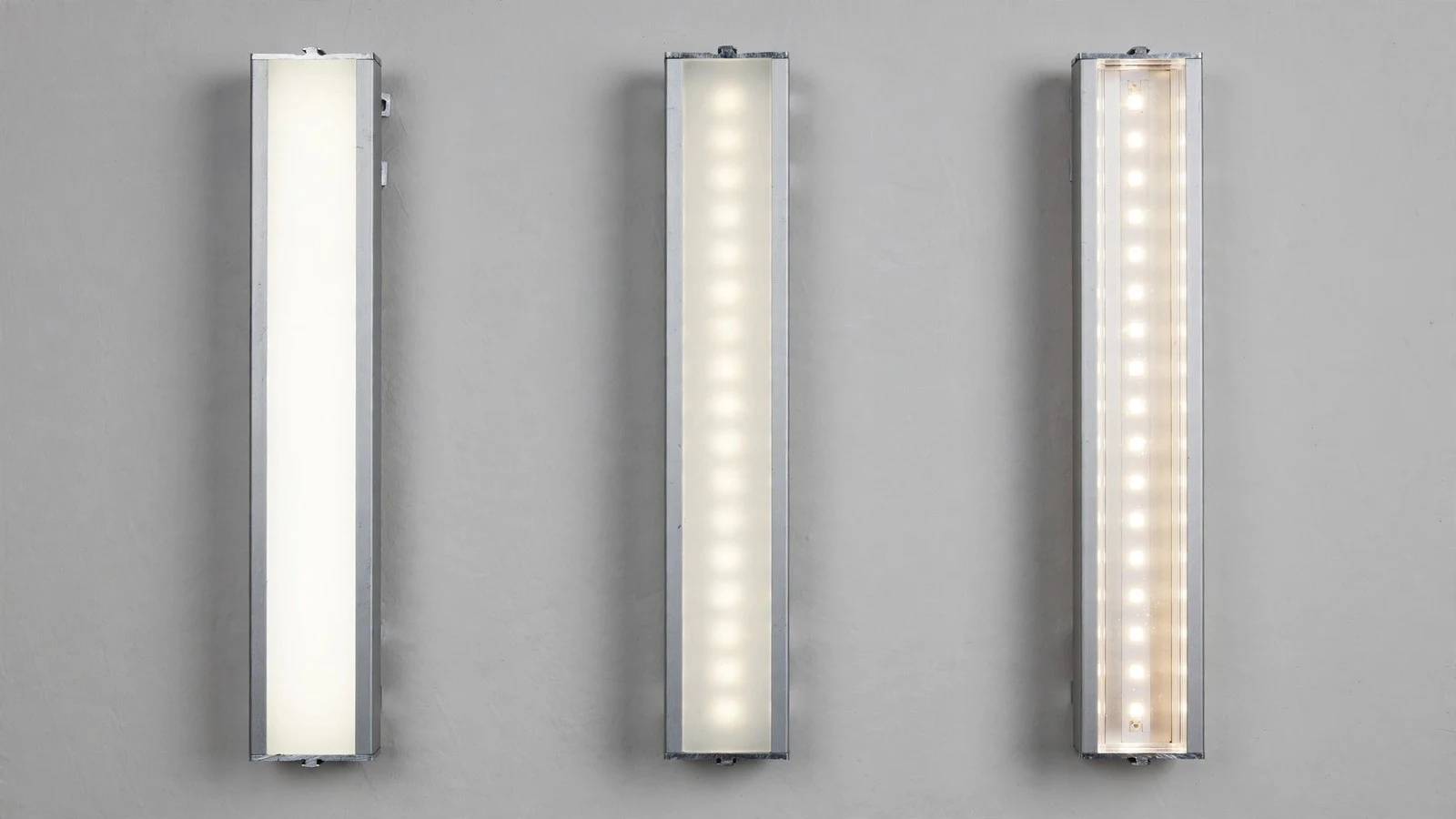
Opal, frosted, and clear are three finishes for the diffuser cover of an LED aluminum profile. Each one changes how the light leaves the strip, how visible the LED dots are, and how the fixture looks when it is off. Opal gives the smoothest line of light and the strongest glare control.
Frosted sits in the middle, softening the dots while keeping more of the light, and clear keeps the most light but shows every dot. Your choice depends on whether people will look straight at the fixture or only at the light it throws.
This guide compares the three finishes side by side. It explains how each one scatters light, how depth and density change the result, and how to pick one by viewing angle. It also tells you what to ask a supplier before you order. The exact transmittance and haze of a diffuser depend on the specific model. Use this guide when you choose a diffuser, or when you replace one that does not look right.
Opal vs frosted vs clear at a glance
The table below gives the short answer, so read it first, then use the sections below to check the details that matter for your project. All three finishes fit the same profile in most cases, so the choice is about light quality.
| Finish | Appearance | Light transmission tendency | Visible dots | Glare | Appearance when off | Best use |
|---|---|---|---|---|---|---|
| Opal | Milky white, solid look | Lowest of the three | None or nearly none | Softest, lowest glare | Milky white strip | Direct view, shelves, kitchens |
| Frosted | Translucent, lightly textured | Middle | Softened, may still show | Moderate, reduced glare | Lightly hazed strip | General use, brightness with comfort |
| Clear | Transparent, glass-like | Highest of the three | Fully visible | Strongest glare | See-through, strip visible | Indirect lighting, coves |
In short, opal hides the dots best and clear keeps the most light, while frosted is the compromise between the two. The rest of this guide explains why that is, and when the compromise is the right call.
How each finish handles light
The difference starts with how each finish treats the light. Clear does nothing to the light at all, while frosted scatters it at the surface. Opal scatters it through the whole thickness of the cover. That difference explains what you see in the finished line.
Clear: no scattering
A clear diffuser is a plain, transparent cover. Light passes straight through it, so almost all of it reaches the room. The trade-off is that nothing hides the individual LEDs. Each chip shows as a bright dot, and the gaps between chips show as dark spots. A clear cover gives no help with glare, because the full brightness of each chip reaches your eye.
Frosted: surface scattering
A frosted diffuser has a textured surface, made by etching or blasting the material. The texture breaks up the light as it leaves the cover, so the dots soften and the line looks more even. The scattering happens only at the surface, not through the body of the cover. That is why frosted keeps more light than opal, while hiding much of the dot pattern.
Opal: bulk scattering
An opal diffuser has tiny particles mixed through the whole material. Light is scattered as it passes through the cover, so it leaves the surface evenly in all directions. That gives the smoothest line of the three, with no visible dots. It also gives the softest light and the lowest glare, because brightness spreads across the whole cover. The cost is light: some is scattered back or absorbed, so opal passes the least light.
In light output, clear passes the most, frosted sits in the middle, and opal passes the least. The exact gap depends on the model, so do not plan around a fixed gap. Ask the supplier for measured transmittance and haze data for the exact model. Our PC vs PMMA LED diffuser guide explains how the base material also changes the result.
Profile depth and strip density change the gap
The finish is only half the story. How deep the profile is, and how closely the LEDs sit, change how big the gap looks. A shallow profile puts the strip close to the diffuser, and a deep profile gives the light more room to spread. Both matter when you judge whether a finish will hide the dots.
In a deep profile, even a frosted cover can look dot-free, because the light has spread by the time it hits the cover. In a shallow profile, the same cover may still show dots, because each chip is too close to the cover to blend. Opal is the most forgiving, because its bulk scattering hides dots even in shallow profiles. Clear shows dots in both cases, so depth alone does not fix it.
Strip density
Strip density works the same way. A strip with many LEDs per meter packs the chips close together, so their light overlaps and the dots blend. A strip with few LEDs per meter leaves wide gaps, so dots stay visible. High density narrows the gap: frosted starts to look like opal. Low density widens it: only opal fully hides the pattern. Our dot-free LED strip lighting guide explains how to plan density and depth for a clean line.
The practical rule is simple: if your profile is shallow or your strip is sparse, do not rely on frosted to hide the dots. Choose opal, or change the profile or the strip. If your profile is deep and your strip is dense, frosted may give you an even line while keeping more light. Test the real combination before you order in bulk.
Choose by how the light will be seen
The fastest way to choose is to ask one question: will people look at the fixture, or only at the light it throws? The answer points straight to a finish. Direct view needs the smoothest line, indirect lighting needs the most light, and general use sits between the two.
- Direct view at eye level, such as under-cabinet strips and retail displays: choose opal.
- Indirect lighting, such as cove lighting and ceiling washes: choose clear.
- General lighting where the fixture is seen but not stared at: choose frosted.
- Low ceilings or close viewing distance: choose opal, because glare is harder to avoid.
- Brightness-first installs where dots do not matter: choose clear.
- Projects where you are unsure: order samples of opal and frosted, and compare them in place.
The viewing angle rule also explains why one diffuser can look right in one project and wrong in another. A frosted cover in a cove looks bright and even, because no one sees the cover. The same cover under a cabinet may still show dots, because the cook looks straight at it. Judge the finish in the place it will be used, not on a bench.
The strip affects the result, since a COB strip blends more easily than a sparse SMD strip and needs less help from the diffuser. Our guide to COB vs CSP vs SMD LED strips explains how the three strip types differ, and which one suits a dot-free line.
What to ask before you order
Do not order a diffuser on the finish name alone. Two covers sold as opal can pass different amounts of light, because material, thickness, and mix vary by model. Ask the supplier for measured transmittance and haze data for the exact model, in writing. If the supplier cannot give measured data, treat that as a warning.
Order a sample of the exact profile, strip, and diffuser together. Test it in the real place, at the real mounting height, and from the angles people will use. A sample also shows how the fixture looks when off, which matters in visible installs. An opal cover shows a milky white color when off, while a clear cover shows the strip inside.
Check the diffuser width against the strip width. A cover too narrow for the strip leaves the edges uneven, and one far too wide wastes the profile. Our LED profile diffuser range lists the diffuser options for NIUYUAN profiles, so you can match the cover to the profile.
How this guide differs from our other diffuser guides
NIUYUAN already covers nearby topics, and each answers a different question. Our dot-free guide and diffuser spot guide explain how to remove visible dots. Our PC vs PMMA guide compares two diffuser materials. This guide does one thing: it compares the three optical finishes, so you can pick one. If your problem is dots, start with the dot-free guide, and if your problem is the finish, this guide is the one to use.
Ordering LED profiles from NIUYUAN
NIUYUAN is a LED aluminum profile manufacturer founded in 2012, with 6 in-house extrusion lines and OEM/ODM support. The company is ISO 9001, RoHS and CE certified, and works from a 31,706 m² factory. Profiles use 6063-T5 aluminum alloy, and the minimum order quantity is 1000 pieces, with lead time of 20–30 days from prepayment.
In-stock profiles ship in 3–7 days, while custom profiles take 25–30 days. New tooling takes about 7 days, standard samples take about 7 days, and samples are free with freight collect. Ask for measured transmittance and haze data for the diffuser model you choose before you place a bulk order.
FAQs
What is the difference between opal, frosted, and clear diffusers?
Opal scatters light through the whole cover, so it gives the smoothest line and hides all dots. Frosted scatters light only at the surface, so it softens dots while keeping more light. Clear does not scatter light at all, so it keeps the most light but shows every dot.
Which diffuser hides LED dots best?
Opal hides dots best, because its bulk scattering spreads the light evenly across the whole cover. Frosted softens dots but may still show them in shallow profiles or with sparse strips. Clear hides nothing, so the dots stay fully visible.
Does a diffuser change the color of the light?
A plain opal, frosted, or clear diffuser is not meant to change the color of the light. The strip sets the color, and the diffuser only spreads it. If color accuracy matters for your project, ask for measured data for the exact diffuser model and test a sample.
Which diffuser should I choose for under-cabinet lighting?
Choose opal for under-cabinet lighting in most cases, because people look straight at the strip from close range. Opal hides the dots and keeps glare low. If the profile is deep and the strip is dense, frosted can also work, so compare samples before you decide.
How do I check a diffuser before I order in bulk?
Ask the supplier for measured transmittance and haze data for the exact diffuser model, in writing. Then order a sample of the profile, strip, and diffuser together, and test it at the real mounting height. Look at it from the angles people will actually use before you place a bulk order.
Frequently asked questions
What is the difference between opal, frosted, and clear diffusers?
Opal scatters light through the whole cover, so it gives the smoothest line and hides all dots. Frosted scatters light only at the surface, so it softens dots while keeping more light. Clear does not scatter light at all, so it keeps the most light but shows every dot.
Which diffuser hides LED dots best?
Opal hides dots best, because its bulk scattering spreads the light evenly across the whole cover. Frosted softens dots but may still show them in shallow profiles or with sparse strips. Clear hides nothing, so the dots stay fully visible.
Does a diffuser change the color of the light?
A plain opal, frosted, or clear diffuser is not meant to change the color of the light. The strip sets the color, and the diffuser only spreads it. If color accuracy matters for your project, ask for measured data for the exact diffuser model and test a sample.
Which diffuser should I choose for under-cabinet lighting?
Choose opal for under-cabinet lighting in most cases, because people look straight at the strip from close range. Opal hides the dots and keeps glare low. If the profile is deep and the strip is dense, frosted can also work, so compare samples before you decide.
How do I check a diffuser before I order in bulk?
Ask the supplier for measured transmittance and haze data for the exact diffuser model, in writing. Then order a sample of the profile, strip, and diffuser together, and test it at the real mounting height. Look at it from the angles people will actually use before you place a bulk order.

Share this guide
Tell us what you need
Send Your Project Requirements
Share your contact details and tell us which LED profiles you need.
Explore custom profile options