
Indirect Lighting Ideas for Living Rooms
Hide the LED strips and let the light bounce. Five living room zones, profile choices and buying checks for soft, even indirect lighting.
On This Page
Living room indirect lighting means the LED strips stay hidden so you never see the source directly. Light first hits the ceiling, walls or furniture, then bounces back into the room. The room shows only soft, even light, and no bare source. This guide covers five zones where that trick works best, and what profile to use in each one.
Why Indirect Light Works in a Living Room
A living room serves many jobs at once, since people read, watch TV, talk and rest in the same space. One bright ceiling light cannot serve all of those jobs well. It throws hard shadows and puts glare in the eyes. Indirect light spreads the glow across a surface first, so the result feels calm and the room looks larger.
The idea fits the wider plan for ambient light in a home. Our ambient lighting guide explains the three layers of room light and how they share the work. This article stays with one room and one job. It shows where to hide the strips in a living room, and which profile form fits each spot. Use it as a room checklist, then check the layer guide for the rest of the home.
Five Zones That Carry a Living Room
Most living rooms need only five zones to feel lit. Each zone hides the strip behind an edge, so the glow lands on a surface first. The table lists the zone, the profile form, the install method and the key need. Pick zones that fit your room, not all five at once, since two or three zones often give enough light for an evening.
| Zone | Profile form | Install method | Key requirement |
|---|---|---|---|
| Behind the TV | Surface mount profile with diffuser | Fix to the TV back or the wall behind it | Keep the strip out of sight from the sofa |
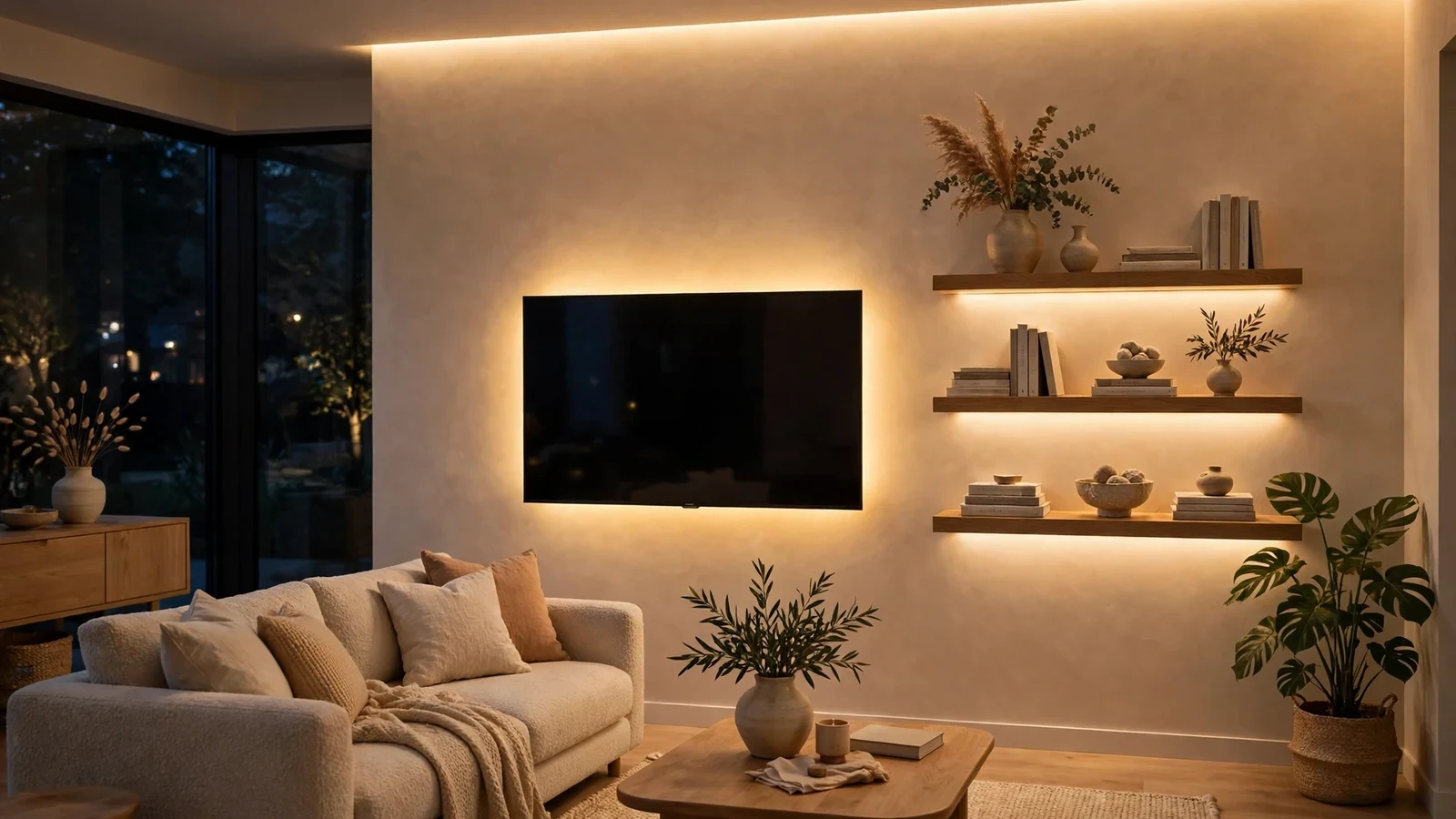
| Under shelves | Slim surface mount or recessed profile | Fix under the front edge of the shelf | Shield the strip so light washes the wall below |
| Behind the sofa | Low surface mount profile | Fix to the wall or the sofa back | Hide the strip from a standing view |
| Fireplace mantel | Slim surface mount profile | Fix under the mantel lip | Keep the strip clear of heat and soot |
| Ceiling cove | Recessed or surface mount cove profile | Set inside the cove ledge | Keep the light line even, with no dark gaps |
Start with the zone you use most in the evening, since one good zone beats several half-lit edges. The TV wall suits rooms where viewing comes first, while the cove suits rooms that need a soft wash everywhere. Add shelves or the sofa back later, once the first zone is in place and you can judge the result. Check the glow from the sofa and doorway first, since a strip hidden from one seat can show from another.
Behind the TV
A strip behind the TV cuts the contrast between the bright screen and a dark wall. The glow makes long viewing easier on the eyes, so mount the profile on the TV back or on the wall just behind it. A diffuser turns the row of points into one even line. Keep the strip set back from the edge, so no bare strip shows from the sofa. This zone suits a surface mount profile.
Under Shelves
Shelves give the easiest win in a living room, since a strip under the front edge washes the wall below with soft light. It also lights books and objects without a visible source. Fix the profile to the shelf underside, set back a little from the front. A slim profile fits best, since deep profiles stick out below the shelf. Use a diffuser here too, so the glow stays even along the whole shelf.
Behind the Sofa
A strip behind the sofa adds a soft halo to the seating area. It works best when the sofa stands a little away from the wall. Mount a low profile on the wall behind the sofa. The key test is simple: stand up and look at the sofa from across the room. If you can see the strip, move it lower or further back, since the glow should appear to come from nowhere.
Fireplace Mantel
A mantel shelf is a natural place for a hidden strip, since the light under the mantel lip warms the wall above the fire. It suits rooms where the fireplace is the visual centre, so keep the strip clear of direct heat and soot. A slim surface mount profile fits under most mantel lips. Check the heat at the spot before you fix anything, and keep the driver and wiring away from the hot zone.
Ceiling Cove
The ceiling cove gives the largest wash of light in the room, since a strip inside the ledge throws light up across the ceiling. This zone needs the most care, since a gap in the line shows at once. Read our cove LED profile guide before you order. It covers cove choice in depth, from profile depth to diffuser fit. A recessed profile suits a deep cove, and a slim surface mount profile suits a shallow ledge.
Common Mistakes to Avoid
Most failed living room jobs share the same few errors, and the list below covers the ones we see most often. Check each item before you order, and again before you fix the profiles in place, since a short check now saves a rework later.
- Leaving the strip visible from the sofa or the doorway. Walk the room and check every viewing angle first.
- Breaking the light line at a corner or a joint. Plan the full run, and ask how joints are made.
- Lighting only one zone and leaving the rest dark. Two or three zones beat one bright line.
- Mixing colour temperatures in one room. Keep one colour temperature across all zones.
- Skipping the diffuser. Bare strips show as dots, not as a line. Hold a sample diffuser over the strip first, so you can see the line before you order.
- Choosing a profile that is too deep for the shelf or mantel. Measure the lip first.
- Forgetting dimming. A room needs low light at night and more light for reading. Ask how dimming works with the strip you plan to use, and test it on a sample run first.
- Ordering without a sample. Check the profile and diffuser in hand before a bulk order. A sample also shows whether the diffuser fits the profile and the finish suits the room.
Choose the Right Colour and Brightness
Colour temperature sets the mood of the room. Warm white from 2700K–3000K suits most living rooms, since it feels calm in the evening. Cool white can feel harsh after dark, and it fights the warm light from lamps. Our LED colour temperature guide explains the scale and where each range fits. Match every zone to the same temperature, so the room reads as one space.
Colour rendering matters as much as colour temperature, since a high CRI shows wood, fabric and skin tones as they really are. Low CRI light can make a warm room look flat and grey, so ask for the CRI value in writing before you order. Our CRI guide explains the scale and what to ask a supplier. Check the CRI on a sample before you order in bulk.
What to Ask Before You Order
Profiles are only part of the order. Ask how the strips run end to end, and how corners and joints are handled. Ask which diffuser fits the profile, and whether it keeps the light even on a long run. Ask about dimming, and whether the profile suits the dimming method you plan to use. NIUYUAN supplies the aluminium profiles, not the LED strips or drivers, so confirm the strip and driver choice with their own suppliers.
Ask how a long run is joined, and what happens at a corner, since a break shows at once. A run that looks even on a short sample may show a break where two lengths meet. Ask for the join in writing, so the order covers the full length of each zone. Then check the join on a sample run before the bulk order goes in.
Order terms matter for a bulk buy, since NIUYUAN works to a uniform MOQ of 1,000 pieces, with new tooling in about 7 days. Lead time runs 20–30 days from prepayment, and custom orders take 25–30 days, while in-stock profiles ship in 3–7 days.
Samples are free with freight collect, and standard samples take about 7 days, so ask for a sample first. Profiles use 6063-T5 aluminium alloy, and the factory holds ISO 9001, RoHS and CE certification. The factory covers 31,706 m² and runs 6 extrusion lines. It has completed 36,000+ projects across North America, Europe, the Middle East and Oceania. Check the profile, diffuser and finish in hand before you order.
Frequently asked questions
What is indirect lighting in a living room?
It means the LED strips stay hidden, so you never see the source. Light bounces off the ceiling, walls or furniture first, and the room shows soft, even light with no glare. That bounced light is what makes the room feel calm.
Where should I put indirect lighting in a living room?
Start with the TV wall, under shelves, or a ceiling cove, since two or three zones give a balanced result. Add the sofa back or mantel only if the room still feels dark, and check the glow from the sofa before you fix anything.
Do LED strips need an aluminium profile for indirect lighting?
Yes, in most cases. A profile holds the strip straight, helps it cool, and carries a diffuser. The diffuser turns a row of dots into one even line of light, which is the whole point of indirect lighting.
What colour temperature suits a living room?
Warm white from 2700K–3000K suits most living rooms, since it feels calm in the evening. Keep one temperature across all zones, so the room reads as one space. Check our colour temperature guide for the full scale before you buy.
Can I order custom profiles for a living room project?
Yes. NIUYUAN makes custom aluminium profiles to order, with a uniform MOQ of 1,000 pieces. New tooling takes about 7 days, and custom orders take 25–30 days. Samples are free with freight collect, so check a sample before a bulk order.

Share this guide
Tell us what you need
Send Your Project Requirements
Share your contact details and tell us which LED profiles you need.
Explore custom profile options