
LED Aluminum Profiles vs Extrusions: Are They the Same Thing?
LED aluminum profiles, extrusions and channels: are they the same product? See what each term means, when to use which word, and what to ask your supplier.
On This Page
LED aluminum profiles, LED aluminum extrusions, and LED channels are the same product in everyday buying language. The three words point at different parts of one thing, and that is why they cause confusion.
A profile is the shape, while an extrusion is the process that makes the shape and the product that comes out of it. A channel is the common name for the housing that holds the strip. Use the wrong word in the wrong place, and a supplier may send a bare length when you expected a complete kit.
01. What each term means
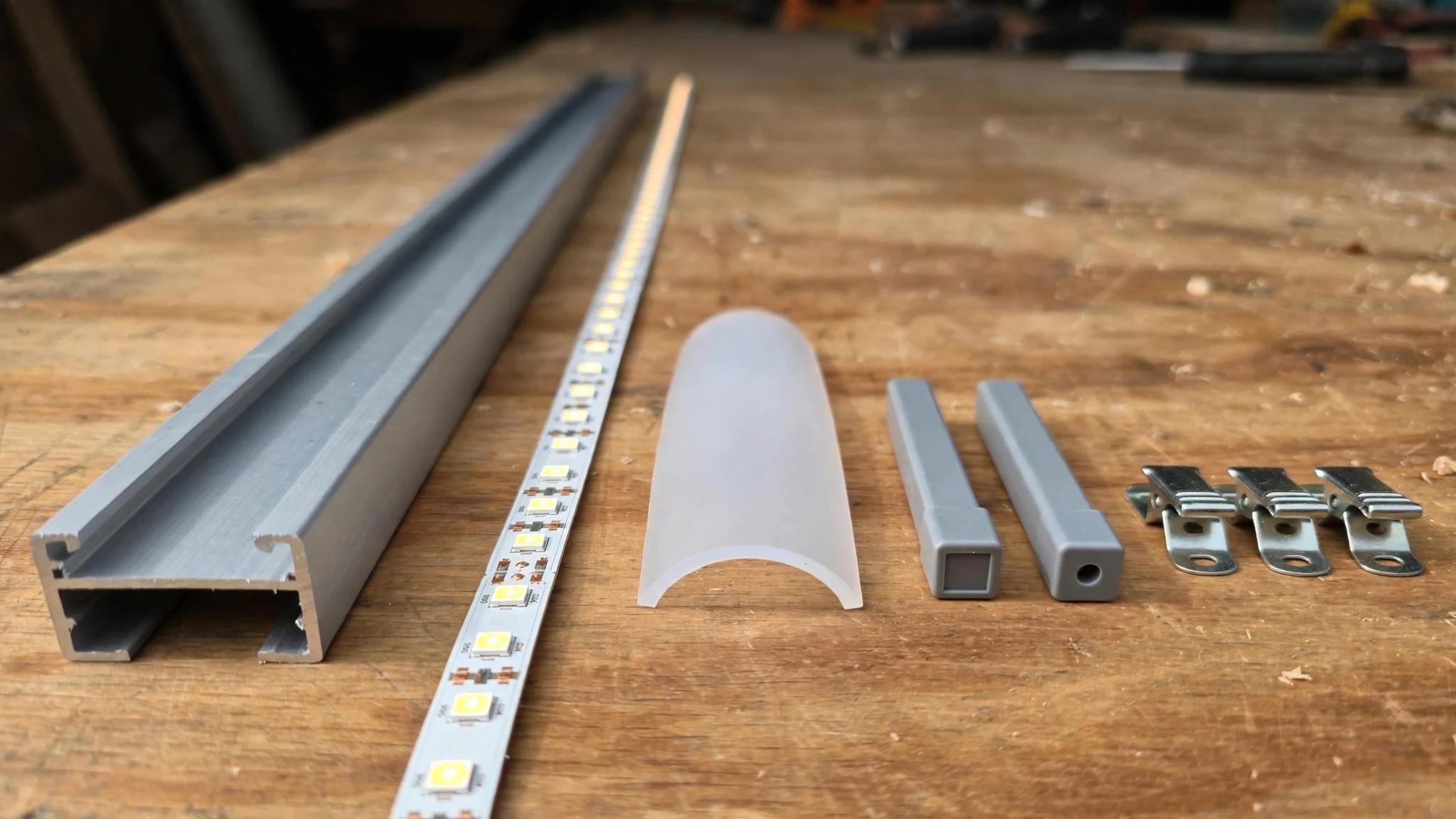
Start with the word profile: in this trade, it is the cross-section shape of the aluminum. By extension, it also means the finished channel system built around that shape. The shape decides the width, the depth, the slot for the strip, and the seat for the diffuser. When a buyer says profile, they usually mean the whole system: the aluminum body, the diffuser, the end caps, and the clips.
Extrusion is a process word, and it names the way the shape is made. A heated aluminum billet is pushed through a die, and the die gives the metal its cross-section. The word also names the product of that process. A length of aluminum that comes out of the die is an extrusion, even before anyone fits a strip or a diffuser to it.
Channel is the plainest of the three words, and it names the housing that holds the LED strip. On drawings and in quotes, channel is the word most buyers meet first. It says nothing about the process, only that the part is a long housing with a slot for light.
One more word shows up in catalogues: linear fixture. It means the finished light as a whole, strip included. A profile is part of a linear fixture, and an extrusion is how that part was made. Keep the three levels apart, and the words stop fighting each other.
02. The three words side by side
The table below puts the words side by side, so read it as a usage guide, not as a list of three different products. The same length of aluminum can be all three at once, depending on who is talking about it and why.
| Term | What it points at | When to use it | What it does not mean |
|---|---|---|---|
| Profile | The cross-section shape, and the finished channel system | Ordering a complete system; talking about shape and fit | It does not name the process |
| Extrusion | The process, and the product that comes out of the die | Talking about how the shape is made; ordering a bare length | It does not promise a diffuser or end caps |
| Channel | The housing that holds the LED strip | Drawings, quotes, and everyday buying talk | It does not say how the housing was made |
| Die | The tool that shapes the cross-section | Talking about tooling and custom shapes | It is not a product you buy on its own |
03. How an extrusion becomes a profile
The process is simple to picture: a billet of aluminum is heated until it is soft enough to flow. A press pushes it through a die, which is a steel plate with the cross-section cut through it. The metal comes out on the other side in the shape of the cut. Think of toothpaste coming out of a tube: the opening decides the shape.
The shape stays the same along the whole length, and that is the point of the process. A single die can make long runs with a steady cross-section, and the runs can be cut to the lengths a project needs. The diffuser seat, the strip slot, and the fixing grooves are all part of the same cross-section, formed in one pass.
This is why the two words overlap: the extrusion is the thing that comes out of the die. The profile is the shape it comes out in. A supplier who says extrusion is talking about the making, while a buyer who says profile is talking about the shape and the system. Both are describing the same length of aluminum.
04. Where the confusion costs money
The words cost money when they decide what ships. A buyer who writes extrusion on an order may get a bare length of aluminum. No diffuser, no end caps, no clips. The part is correct by the word used, and wrong for the job. A buyer who writes profile usually gets the complete system, but only if the supplier reads the word the same way.
Drawings cause the same trouble: a note that says aluminum extrusion tells the installer how the part was made. It does not tell them what else to fit. A note that says LED channel, complete with diffuser, end caps, and clips leaves no gap. Spell out the kit, not just the process.
Quotes are the third trap. Two suppliers can quote the same word and mean different kits. One prices a bare length, and the other prices the full system. The cheaper quote looks better until the missing parts are added. Ask every supplier the same question: what is in the kit, and what is extra?
Custom work makes the words matter more, because a custom section starts from a drawing of the cross-section. The die is cut to that drawing, so if the order uses different words from the drawing, the tooling can be cut wrong. Agree the words before the die is cut, not after.
05. Mounting types and the words that go with them
The same three words travel across every mounting type. The shape changes, but the language does not. A surface mount section sits on the face of a ceiling or wall. A recessed section sits inside it, a corner section fits a 45-degree joint, and a suspended section hangs from cables. A plaster-in section hides behind compound and paint. NIUYUAN makes all five, plus drywall and bendable sections, and each one is still a profile, an extrusion, and a channel at once.
The mounting type is part of the section, not a separate product, so when you name the mounting, you name the shape. Say recessed profile and the supplier hears a section made to sit in a slot. Say surface channel and they hear a section made to sit on a face. The mounting word does the work that profile alone cannot do. See how to choose the right LED aluminum channel.
- Surface mount: a profile that fixes to a face. Call it a surface channel.
- Recessed: a profile that sits in a slot. Call it a recessed channel.
- Corner: a 45-degree profile for joints. Call it a corner channel.
- Suspended: a profile that hangs from cables. Call it a suspended channel.
- Plaster-in: a trimless profile with wings for compound. Call it a plaster-in channel.
06. What to ask your supplier
Before you order, run through this list with the section drawing in hand, and give every item an answer. Any item without an answer is a question for the supplier, not a detail to settle on site.
- Section drawing: does the drawing show the full cross-section, with the strip slot and the diffuser seat?
- Wall thickness: what is the wall thickness of this section, and does it suit the span?
- Diffuser: which diffuser comes with the kit, and is it included in the price?
- End caps and clips: are end caps and fixing clips in the kit, or are they extra?
- Cut lengths: can the supplier cut to the lengths on the drawing, and how are cut ends finished?
- Finish: what finish does the section carry, and does it match the project?
- Custom section: if no standard section fits, can the supplier cut a die to your drawing?
- Samples: can you see a finished sample, lit, before the order goes out?
A supplier who answers all eight has read the same words you used, and one who cannot answer them has not. That is the real test of the terminology: not whether the words sound right, but whether both sides mean the same kit. If the strip itself will also need power without a plug, see our guide to power LED strips without a plug.
07. How this guide differs from the selection guides
This guide answers one question: what do the words mean? It does not choose a profile for you. For the choice itself, start with the guide to choosing the right LED aluminum channel. It walks through width, depth, diffuser, and mounting, step by step.
Then read the guide to choosing the best LED aluminum channel, which compares the shortlist on the points that matter most. Use this page to speak the same language as your supplier. Use those pages to pick the section.
For a section no catalogue covers, the custom route starts from your drawing. Share the section, the strip data, and the space the fixture must fit. The supplier can then confirm whether a standard section works, or whether a new die is the right answer.
Frequently asked questions
Are LED aluminum profiles and LED aluminum extrusions the same thing?
In everyday buying language, yes. A profile is the cross-section shape. An extrusion is the process that makes it, and the product that comes out of it. One guide puts it in a single sentence: "They are the same product." The words differ in what they point at, not in the part they name.
What does "LED channel" mean?
It is the common name for the aluminum housing that holds an LED strip. It says nothing about how the housing was made. On drawings and in quotes, it is the plainest of the three words, and the one most buyers meet first.
What is a die in aluminum extrusion?
A die is the steel tool that shapes the cross-section. The billet is pushed through it, and the metal comes out in the shape of the cut. Each section needs its own die, which is why a custom shape starts with a drawing.
If I order an "extrusion", do I get the diffuser and end caps?
Not necessarily. The word extrusion names the process and the bare length that comes out of it. It does not promise a diffuser, end caps, or clips. Always ask what is in the kit, and confirm the full component list before you order.
What should I write on a drawing or an RFQ?
Write the full kit, not just the process. A note such as "LED channel, complete with diffuser, end caps, and clips" leaves no gap. Add the mounting type, the section drawing, and the cut lengths, and ask the supplier to confirm the list.

Share this guide
Tell us what you need
Send Your Project Requirements
Share your contact details and tell us which LED profiles you need.
Explore custom profile options