
Angled LED Extrusions for Corners and Cove Details
Angled LED extrusions light 90° corners without dark spots. Compare V-shape, adjustable and recessed forms and beam angles, then order with confidence.
On This Page
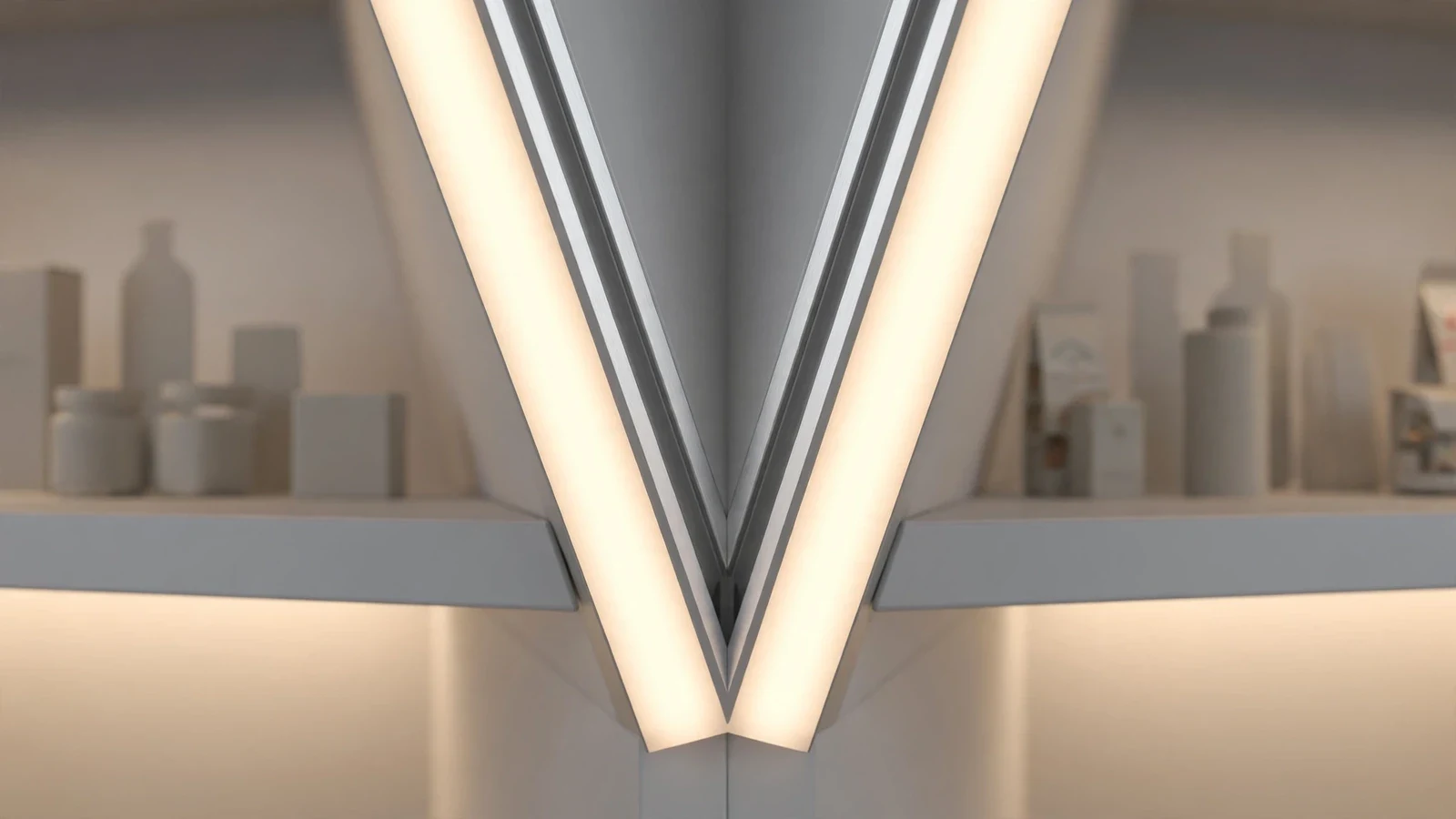
An angled LED extrusion is an aluminum profile that sits at a 90° corner and throws light out at an angle. The corner stays lit while the light spreads evenly across both faces. The phrase corner profile has two meanings, and they are easy to mix up. One is this aluminum extrusion, which holds the LED strip. The other is a small electrical connector that joins two strip ends around a corner.
This guide covers only the extrusion, and it explains the main forms, the beam angles, and how to match a form to a scene. A corner is a hard place to light, because a flat strip on one face leaves the other face dark. A strip bent around the corner breaks the light line, while an angled profile solves both problems at once.
What an Angled LED Extrusion Does at a Corner
A corner profile mounts where two surfaces meet at a right angle. The strip sits inside the profile, and the diffuser faces outward at an angle. The light leaves the profile on a diagonal line and washes both surfaces at once instead of favoring one side. That is the whole idea, and it works in cabinets, coves and shelves alike.
The most common beam angle is 45°, and a 45° profile splits the light evenly between the two faces. Some profiles offer 30° or 60° instead for corners where one face needs more light. A 30° angle favors one face, while a 60° angle favors the opposite face. Choose the angle after you decide which surface needs more light.
A corner profile also protects the strip. The aluminum body draws heat away from the LEDs and shields the strip from dust and knocks. The diffuser keeps the light even and keeps fingers off the strip. In a kitchen or a shop, that protection matters as much as the light itself. Choose a profile with a diffuser that clips on firmly and stays put.
How the Beam Angle Changes the Result
Beam angle decides where the light lands, not how bright the strip is. A steep angle pushes light deep into a room, while a shallow angle keeps it close to the wall. The wrong angle can leave a bright stripe on one face and a shadow on the other. Test the angle with a sample before you order in bulk. A short sample run shows the pattern better than any drawing.
Distance matters as much as angle, because a profile mounted far from the lit surface spreads light more softly. A profile mounted close to the surface makes a sharper line, so plan the mounting distance first and then pick the angle. In a display cabinet, the shelf below is close, so the beam stays tight. In a cove, the ceiling is farther away, so the same profile gives a softer wash.
Test the beam with the diffuser fitted, not with a bare strip, because the diffuser softens the edge of the beam and hides the dots. A test with a bare strip can look bright and even, then disappoint once the diffuser is on. Mount the sample at the real distance and look at it from the usual viewing point. That small test answers most angle questions at once.
Four Corner Profile Forms Compared
Most corner profiles fall into four forms, and each form fits a different corner and a different job. The table below compares them side by side, so use it to narrow the choice before you ask a supplier for samples.
| Form | Fits this corner | Light direction | Key requirement |
|---|---|---|---|
| V-shape 45° | Sharp 90° corner | Out at 45° | Profile sits flush in the joint |
| Adjustable angle | Corners that vary | 30° to 60° | Hinge holds the set angle |
| Recessed corner | Plastered or grooved corner | Out at 45° | Groove depth matches the profile |
| Bendable transition | Rounded or wide corner | Follows the curve | Curve radius suits the profile |
The V-shape 45° form is the default choice for most corners, because it is simple, it mounts fast, and it suits cabinets and shelves. Adjustable profiles cost more, but they help when the corner is not a true right angle. Recessed forms hide the profile body and leave only the light line visible, while bendable profiles handle curves that rigid forms cannot follow. See the guide to bendable profiles for curved ceilings.
Where Each Form Fits Best
The same corner profile can look right in one scene and wrong in another, because the scene decides the form, not the other way around. A display cabinet needs a clean line and no glare, while a cove needs a soft wash across a wide ceiling. A kitchen cabinet needs light on the worktop below, so match the form to the scene first and then check the size.
| Scene | Recommended form | Why it works |
|---|---|---|
| Display cabinet | V-shape 45° | Even light on shelves, no direct glare |
| Cove or ceiling edge | V-shape 45° or recessed corner | Soft wash across the ceiling plane |
| Under-cabinet corner | Adjustable angle | Aims light at the worktop, not the wall |
| Retail shelf | V-shape 45° | Bright edge light without hot spots |
Cove lighting deserves a closer look, because the profile is often hidden and the ceiling does the work. The light leaves the corner at an angle and spreads across the ceiling, while a recessed corner profile keeps the fitting out of sight. For cove layouts, diffuser choice and mounting height, see the cove and indirect lighting guide.
Diffuser Choice Matters at Corners
The diffuser shapes the light as much as the profile does. A clear diffuser passes the most light, but it can show the dots of the strip. A frosted diffuser softens the line, and an opal diffuser hides the dots best. At a corner, dots are easy to see, because the eye looks straight at the angled face. Choose the diffuser after you test a sample at the real viewing angle.
Do not judge a diffuser from a photo alone, because photos hide the dot pattern and the glare. Ask for a sample with the diffuser fitted, then look at it from the angle people will use. For the trade-offs between the three common diffuser types, see the opal, frosted and clear diffuser comparison.
Common Mistakes When Choosing Corner Profiles
Most corner lighting problems come from a small choice made early. The profile was right, but the angle, the diffuser or the strip width was wrong. The list below covers the mistakes buyers make most often, so check each one before you place an order.
- Mistaking the connector for the profile. A corner connector joins two strip ends, but it holds no strip and shapes no light. Order the extrusion as well, or the corner will stay dark.
- Leaving a gap at the corner. Two straight profiles that stop short of the joint leave a dark break. Plan the corner piece first, then cut the straight runs to meet it.
- Picking the angle by guesswork. A 45° profile suits a true right angle, but a corner that is off square needs an adjustable form. Measure the corner before you choose.
- Choosing the wrong diffuser. A clear diffuser at eye level shows every dot, so use a frosted or opal diffuser where people look straight at the profile.
- Forgetting the strip width. A strip wider than the profile channel will not sit flat, so ask for the inner width and match it to your strip before ordering.
Questions to Ask Before You Order
A short list of questions saves more time than a long catalog search. Ask them before you order, and ask for the answers in writing. The list works for any supplier and for any corner profile form. Keep the sample on hand while you ask, so the answers match the part you will receive.
- What beam angles does this profile offer, and is the angle fixed or adjustable?
- What is the inner width of the channel, and which strip widths fit it?
- Which diffuser options come with this profile, and can I test a sample first?
- How does the profile mount at the corner, and what clips or fixings are included?
- What is the minimum order quantity, and what is the lead time for a custom length?
- Can I order a standard sample first, and how long does the sample take to arrive?
Ordering Corner Profiles from NIUYUAN
NIUYUAN builds LED aluminum profiles in 6063-T5 alloy on six in-house extrusion lines. The factory covers 31,706 m² and holds ISO 9001, RoHS and CE certification. Orders ship to North America, Europe, the Middle East and Oceania, and more than 36,000 projects have been completed worldwide.
The minimum order is 1,000 pieces, and standard samples are free, with freight collect, and arrive in about 7 days. In-stock profiles ship in 3–7 days, and custom orders take 25–30 days. The standard lead time is 20–30 days from prepayment, and a new mould takes about 7 days. For the wider range of profile choices, see the general aluminum channel selection guide.
A corner profile is a small part, but it decides whether a corner looks finished or forgotten. Pick the form for the scene, test the angle and the diffuser with a sample, and ask the questions above before you order. The right choice gives an even line of light with no dark break at the joint.
Frequently asked questions
What is an angled LED extrusion?
An angled LED extrusion is an aluminum profile that sits at a 90° corner and throws light out at an angle. It holds the LED strip and spreads the light evenly across both faces of the corner.
What beam angle should a corner profile have?
A 45° beam angle suits most true right-angle corners, because it splits the light evenly between the two faces. Use 30° or 60° when one face needs more light than the other.
What is the difference between a corner profile and a corner connector?
A corner profile is an aluminum extrusion that holds the LED strip. A corner connector is a small electrical part that joins two strip ends. This guide covers the profile, not the connector.
Can angled LED extrusions be used in cove lighting?
Yes. A V-shape 45° or recessed corner profile works well in coves, where the angled light washes across the ceiling. Choose the diffuser and the mounting height to match the ceiling distance.
What should I ask before ordering corner profiles?
Ask for the beam angle, the inner channel width, the diffuser options and a sample. Also confirm the minimum order, the lead time and the sample time before you place a bulk order.

Share this guide
Tell us what you need
Send Your Project Requirements
Share your contact details and tell us which LED profiles you need.
Explore custom profile options