
LED Lighting for Wood Panel Walls
Learn how to light a wood panel wall with LED strips in aluminum profiles: in-gap vs routed fitting, profile choice, diffuser tips, and mistakes to avoid.
On This Page
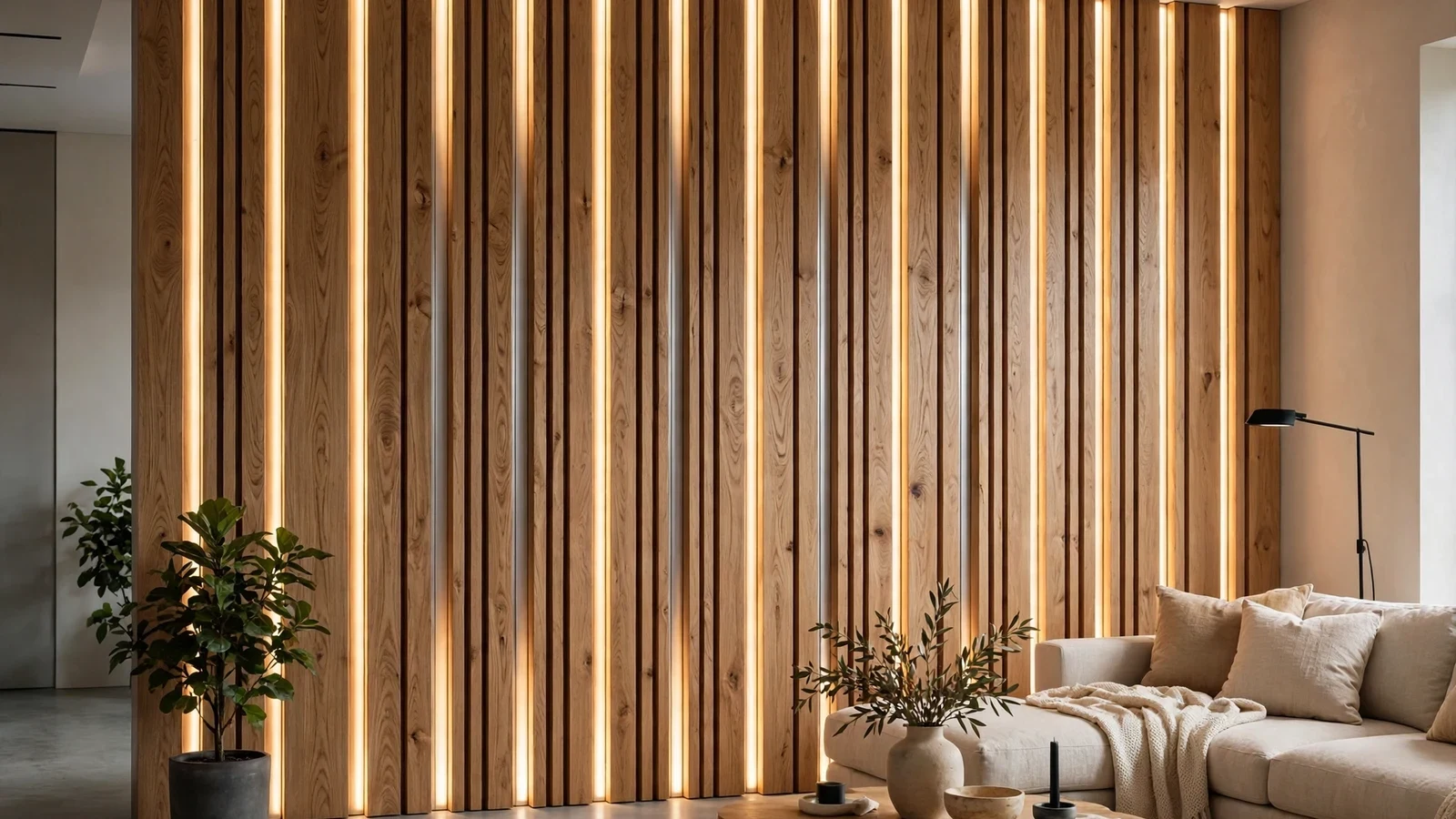
LED lighting for wood panel walls means fitting LED strips into aluminum profiles, then setting the profiles into slat gaps or routed grooves. Light then forms continuous lines along the wood, instead of bare strips stuck onto it. This method suits slat walls, feature walls, and paneled rooms in homes, hotels, and shops. The profile protects the strip, spreads heat, and hides the dots, so the wood keeps its look and the light becomes part of the wall.
A wood panel wall already has a strong visual rhythm. The slats, the gaps, and the grain set the pattern, so light should follow that pattern, not fight it. A bare strip pasted into a gap breaks the rhythm, showing bright dots, dark spots, and glue lines. A profile with a diffuser turns the same strip into one clean line.
This guide compares the two main fitting methods, in-gap fitting and routed groove fitting, for wood panel walls. It lists the questions to ask before you order, and flags the mistakes that waste time and money.
Why Bare Strips Fail on a Wood Panel Wall
A bare strip has no heat sink, so its heat stays where the strip sits. In a narrow wood gap, that heat has nowhere to go, so the strip runs hot and its light fades faster. An aluminum profile acts as a heat sink, pulling heat away from the strip and keeping the output stable. That is the first reason to use a profile, not a bare strip.
A bare strip also shows every dot, since each LED chip is a point of light. On a flat wall, the eye may forgive that. On wood, the dots reflect off the grain and the gap edges. The result looks cheap, even with a good strip, until a diffuser spreads the light into one even line. The profile holds the diffuser at the right distance from the chips, so together they hide the dots.
Glue is the third problem, because wood moves with heat and humidity, and tape that holds on day one can peel in a warm room. A strip that sags in a gap is hard to fix without pulling the wall apart. A profile is fixed with screws or clips, so it stays put and the strip inside it can be replaced. For a wall that should last years, that service access matters.
Strip type also affects the result, since a COB strip gives a smooth line with few visible dots. An SMD strip shows more dots, so it relies more on the diffuser and the profile depth. Either type works in a profile, and the choice is about the look you want and the budget you have. Check a sample of each type on your own wood before you decide.
Two Ways to Fit LED Profiles Into Wood Panel Walls
Most wood panel walls use one of two methods, since the first sets the profile into the gap between slats. The second cuts a groove into a solid panel and sets the profile flush, and both work well. The right choice depends on your wall type, your panel thickness, and the look you want. The table below compares them side by side.
| Method | Profile form | Suitable wood panel | Key requirement |
|---|---|---|---|
| In-gap fitting | Slim surface or shallow recessed profile set between slats | Slat walls with even gaps, acoustic felt backing | Gap width must fit the profile outer width |
| Routed groove fitting | Recessed profile set into a groove, flush with the surface | Solid wood panels, MDF, veneered boards | Groove depth must suit the panel thickness, with enough material left behind |
In-Gap Fitting
In-gap fitting is the simpler job: you measure the gap, pick a slim profile, and fix it between the slats. No cutting into the wood is needed, and this method suits most slat walls, including walls with dark acoustic felt behind the slats. The profile edge may sit slightly proud of the slats, which is fine when the gap is part of the design. A matte black profile blends into the felt and almost disappears when the light is off.
Routed Groove Fitting
Routed groove fitting gives the cleanest finish. The profile sits flush with the panel face, and only the light line shows. It needs a router, a steady hand, and the right panel thickness, since a cut too deep weakens the panel. Cut too shallow, and the profile stands proud, so check the groove depth against the panel thickness before you cut. A sample cut on a spare board is worth the time.
Surface Mount as a Fallback
A third option exists for flat panels that cannot be routed, since a surface mount profile fixes straight onto the panel face. It is easy to fit, but the profile is visible as a raised line. Use it where the line itself is part of the design, such as under a shelf or along a panel edge. For a general guide to profile types, see our article on how to choose an LED aluminum channel.
How to Choose the Right Profile for Your Wall
Ask these six questions before you order, since each one prevents a common failure, from strip width, groove depth, diffuser choice, and color. Answer them with your supplier, and check the answers against a sample.
- Does the profile inner width fit your strip width? A strip that is wider than the channel will not sit flat. Measure both, and leave a small margin.
- Is the groove deep enough, and does the panel stay strong? The groove must hold the full profile depth. Enough material must stay behind it to keep the panel solid.
- Which diffuser gives a clean line? An opal diffuser hides dots best, but it cuts more light. A frosted diffuser keeps more brightness. Our diffuser comparison explains the trade-offs.
- Does the profile color suit the wood? Matte black blends with dark slats and felt. Silver or a wood tone suits pale timber. Ask for a finish sample before a bulk order.
- Where does the driver go, and can you reach it later? Drivers need air and access for service. Plan a hidden spot with a removable cover. NIUYUAN supplies aluminum profiles only, so source the driver separately and check its size against your hiding place.
- Can you check a sample first? A short sample shows the true color, the diffuser effect, and the fit. It costs little and prevents a wrong bulk order.
Color temperature shapes how the wood looks, and warm white is the usual choice for timber, since it brings out the grain. Our color temperature guide explains the options for living rooms and bedrooms. Wood slat walls often sit in living rooms, where the same light doubles as indirect lighting. See our indirect lighting ideas for living rooms for ways to pair wall lines with ceiling glow.
Common Mistakes to Avoid
Most wood wall lighting failures come from small skips, since a missed check at order time becomes a rebuild at install time. Run through each item below before you fit or order, and fix each item now, while it is still cheap.
- Sticking a bare strip straight into a wood gap, with no profile and no heat sink.
- Ordering a profile whose inner width is narrower than the strip.
- Cutting a groove deeper than the panel can take.
- Picking a diffuser that leaves visible dots, or one that dims the line too much.
- Hiding the driver where no one can reach it for service.
- Cutting strips and profiles without leaving room for end caps.
- Skipping a sample check and ordering the full run on a photo alone.
- Forgetting that wood is combustible, and placing hot parts against it without following local codes and the luminaire instructions.
What to Ask Your Supplier Before You Order
Once the design is set, the order questions matter, since a supplier who answers them clearly saves you a second order. Ask for the profile inner width, the diffuser options, and the finish samples in writing. Then confirm the supply terms below.
- Minimum order: 1,000 pieces per order, the same for all aluminum profiles.
- Samples: free, with freight collect. Standard samples take about 7 days.
- Tooling: about 7 days for a new mold.
- Lead time: 20–30 days from prepayment. Custom orders take 25–30 days, and in-stock items ship in 3–7 days.
- Factory: 31,706 m², with 6 in-house extrusion lines. Profiles use 6063-T5 aluminum alloy.
- Certifications: ISO 9001, RoHS, and CE.
- Export: North America, Europe, the Middle East, and Oceania, with 36,000+ projects completed worldwide.
For the fitting steps themselves, see our guide to installing LED strips in aluminum channels, which covers cutting, fixing, and wiring in general terms. The wood wall part is the fitting method in this article, while the general steps are the same.
Start with a sample, not a bulk order, since a sample answers the fit, color, and diffuser questions in one step. It also gives your installer a real piece to test the groove and the gap. Once the sample is right, the bulk order is a repeat, not a risk.
Frequently asked questions
Can I put LED strips directly on a wood panel wall?
You can, but it is a poor choice. A bare strip shows dots, traps heat in the gap, and relies on glue that can peel as the wood moves. Fit the strip into an aluminum profile with a diffuser instead. The profile spreads the heat, hides the dots, and lets you replace the strip later.
What is the best way to hide LED strips in a wood slat wall?
Set a slim profile into the gap between the slats, or cut a groove and fit a recessed profile flush with the panel. The in-gap method is simpler and needs no cutting. The routed method gives a cleaner finish but needs the right panel thickness. Both beat a bare strip.
Do I need a diffuser for wood panel wall lighting?
Yes, in most cases. A diffuser turns the row of LED dots into one even line. An opal diffuser hides dots best but cuts more light. A frosted diffuser keeps more brightness. Pick the diffuser after a sample test, not from a photo alone.
What color temperature suits a wood panel wall?
Warm white is the usual choice for wood. It brings out the grain and feels calm in a living room or bedroom. Cooler white can make pale timber look flat. Test a short sample on your own wood before you order the full run.
Can NIUYUAN supply custom profiles for wood panel walls?
Yes. NIUYUAN makes custom aluminum profiles with a minimum order of 1,000 pieces. Standard samples are free, with freight collect, and take about 7 days. New tooling takes about 7 days. Custom orders take 25–30 days from prepayment, and in-stock items ship in 3–7 days.

Share this guide
Tell us what you need
Send Your Project Requirements
Share your contact details and tell us which LED profiles you need.
Explore custom profile options